

GUEST POST
How to Master A-Level Physics Exam Questions on Circular Motion

Narin is a Mechanical Engineering student at Imperial College London with AAA*A at A-Level, a Distinction in the Mathematics AEA, and over 600 hours of tutoring experience since 2022. She specialises in GCSE and A-Level Maths, Further Maths and Physics, with even her high achieving students typically improving by one or two grades.
Here, she breaks down the topic of circular motion, one of the most consistently misunderstood topics in A-Level Physics, and sets out the single approach that works for every question type.
Quick Hacks for A-Level Physics Circular Motion Questions
By Narin | A-Level Physics and Maths Tutor | Sherpa Tutor
Circular motion questions can take many forms, from a car turning on a flat road to a roller coaster moving through a loop. A core topic in GCSE Physics.
However, the same central idea applies throughout: an object travelling in a circle must have a resultant force acting towards the centre of the circle.
Once you can identify the centre and work out which forces provide this resultant, most circular-motion questions follow the same process.
Foundations to Know Beforehand
Velocity is the rate of change of displacement and is a vector quantity, while speed is the magnitude of velocity.
The time period, T, is the time taken for one complete cycle, measured in seconds.
The frequency, 𝑓, is the number of complete cycles per second, measured in hertz:
f = 1 / T
Circular Motion
In uniform circular motion, speed is constant, but velocity is continuously changing because the direction of motion changes, ideas that are also central to the Mechanics content in A-Level Maths.
Therefore, there must be an acceleration perpendicular to the velocity throughout the rotation. From Newton's second law, this requires a resultant force acting in the same direction as the acceleration, towards the centre of the circle.
Note that the kinetic energy remains constant because the speed is constant, but the momentum changes continuously because it is a vector and its direction changes.
Angular velocity, ω, is the angle moved per unit time:
ω = θ / t
where θ is measured in radians, so the angular velocity has units of rad s⁻¹.
For one complete revolution, θ = 360° = 2π radians. Therefore:
ω = 2π / T and ω = 2πf
Linear speed is related to angular velocity by:
v = ω r
So, two objects rotating through the same angle at the same time have the same angular velocity.
However, the object further from the centre travels a greater distance in that time, so it has a greater linear speed.
Centripetal Acceleration and Centripetal Force
For uniform circular motion:
a = v²/r and a = ω²r
Using F = ma:
F = mv²/r and F = mω²r
Centripetal force is the resultant radial force acting towards the centre of the circle and perpendicular to the instantaneous velocity.
This is an important exam point: centripetal force is not an additional force.
The force towards the centre may be provided by tension, friction, normal reaction, weight, or the resultant of several forces depending on the situation.
So, when drawing a free-body diagram, draw the actual forces acting on the object. Do not add another arrow labelled "centripetal force".
Resolve the actual forces in the radial direction, then set the resultant force towards the centre equal to mv²/r or mω²r.
Also remember:
Normal reaction acts perpendicular to the surface.
Tension acts along the string.
Weight acts vertically downwards.
If there is no acceleration in a particular direction, the forces in that direction must balance.
Horizontal Circular Motion
For an object moving in a horizontal circle, the resultant horizontal force must act towards the centre of the circular path.
For example, when a mass rotates horizontally on a string, the vertical component of the tension balances the weight, while the horizontal component acts towards the centre and provides the required centripetal force.
Effect of Increasing the Speed
To see how the angle changes as the ball rotates faster, divide the two equations:
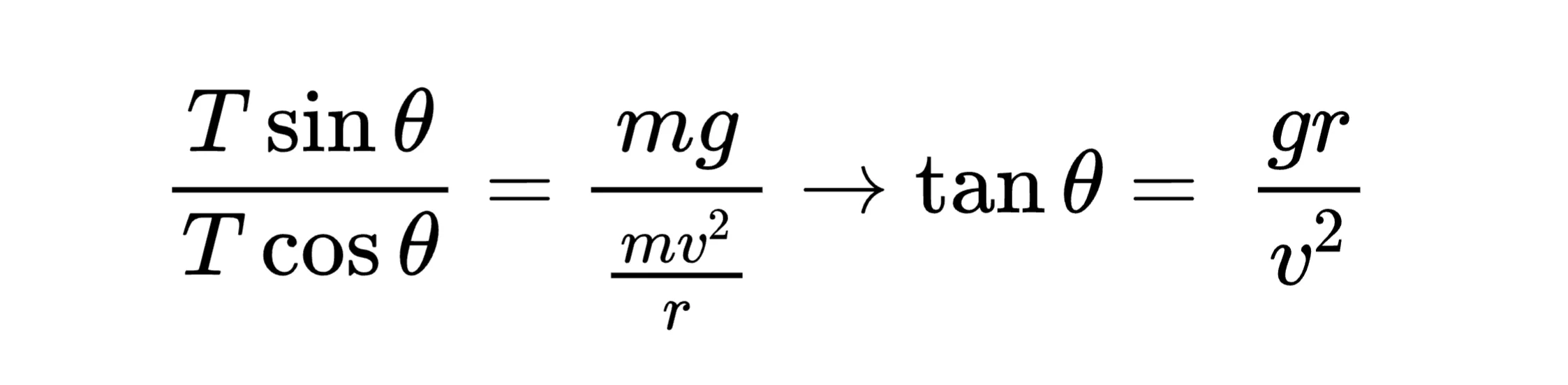
As v increases, tan θ decreases, so θ decreases and the string becomes closer to horizontal.
It cannot become completely horizontal because the tension must always have a vertical component to balance the weight.
Vertical Circles
For vertical circles, the safest approach is not to memorise separate force equations. Instead:
Identify the centre of the circle.
Draw the actual forces.
Decide which forces act towards and away from the centre.
Set the resultant force towards the centre equal to mv²/r.
The force-balance equation changes depending on whether the object is at the bottom of the circle, at the top while moving inside the circle, or travelling over the outside of a curved surface.
The important thing is to establish where the centre is first. This determines which direction is positive when writing the radial force equation.
Losing Contact
When an object is just about to lose contact with a surface, the normal reaction becomes zero:
N = 0
This gives a useful way of finding the limiting speed in circular-motion problems.
Over the top of a curved surface
For a car travelling over a bridge, the centre of the circular path is below the car, so:
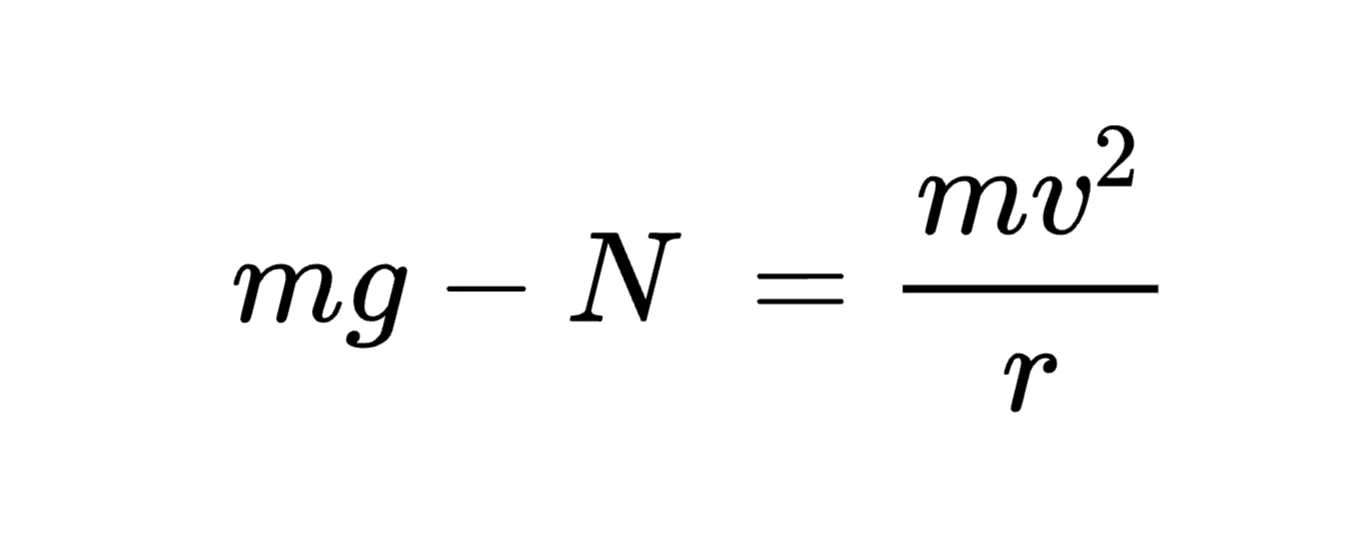
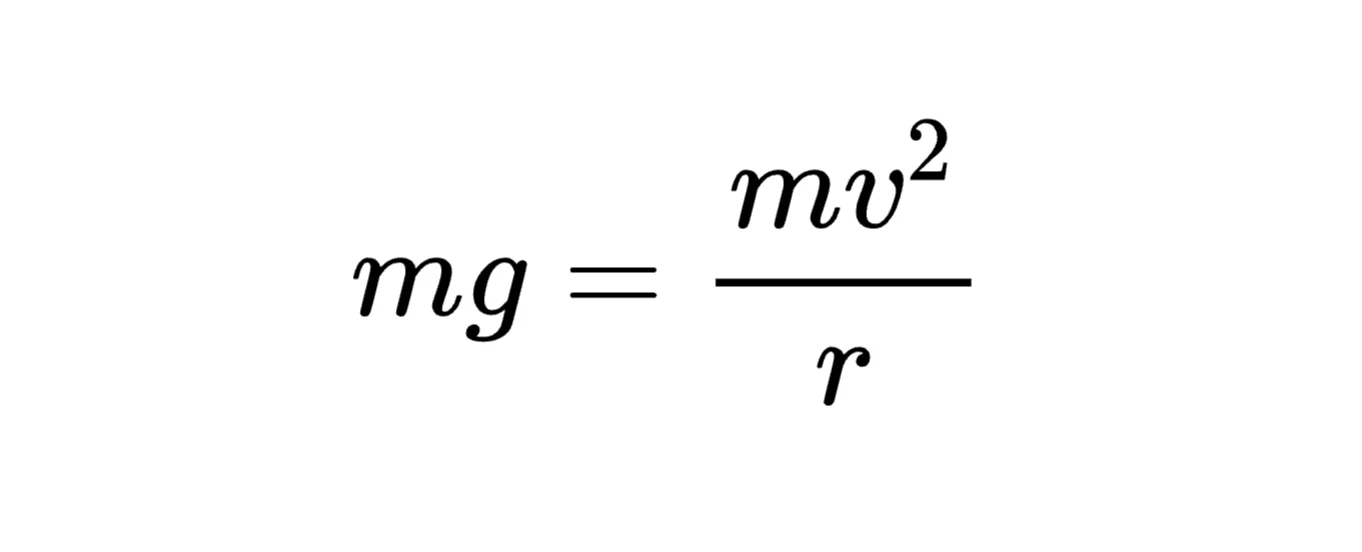
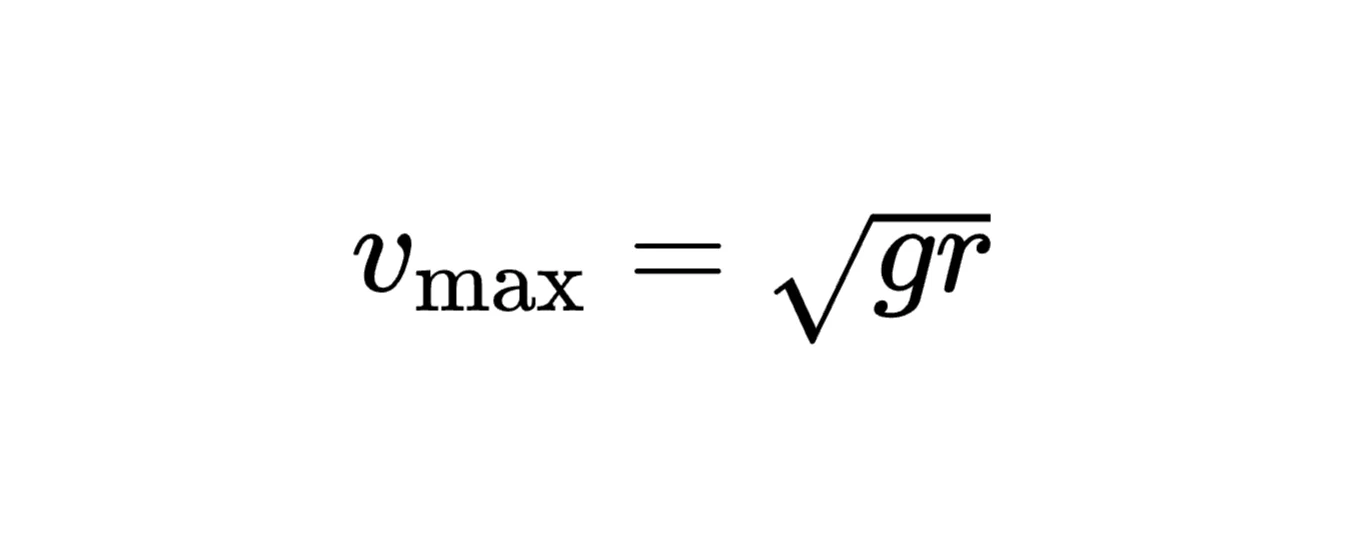
At the maximum speed before contact is lost, N = 0:
At the top of an inside loop
For a carriage travelling around the inside of a vertical loop, both weight and the normal reaction point towards the centre at the top:
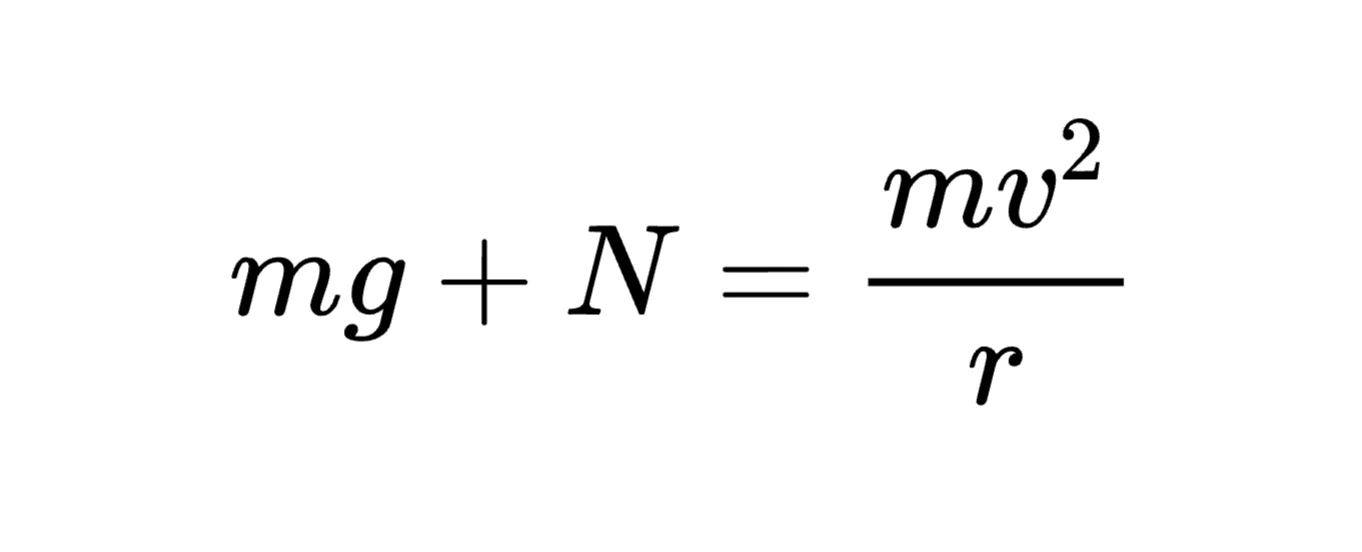
At the minimum speed required to maintain contact, N = 0:
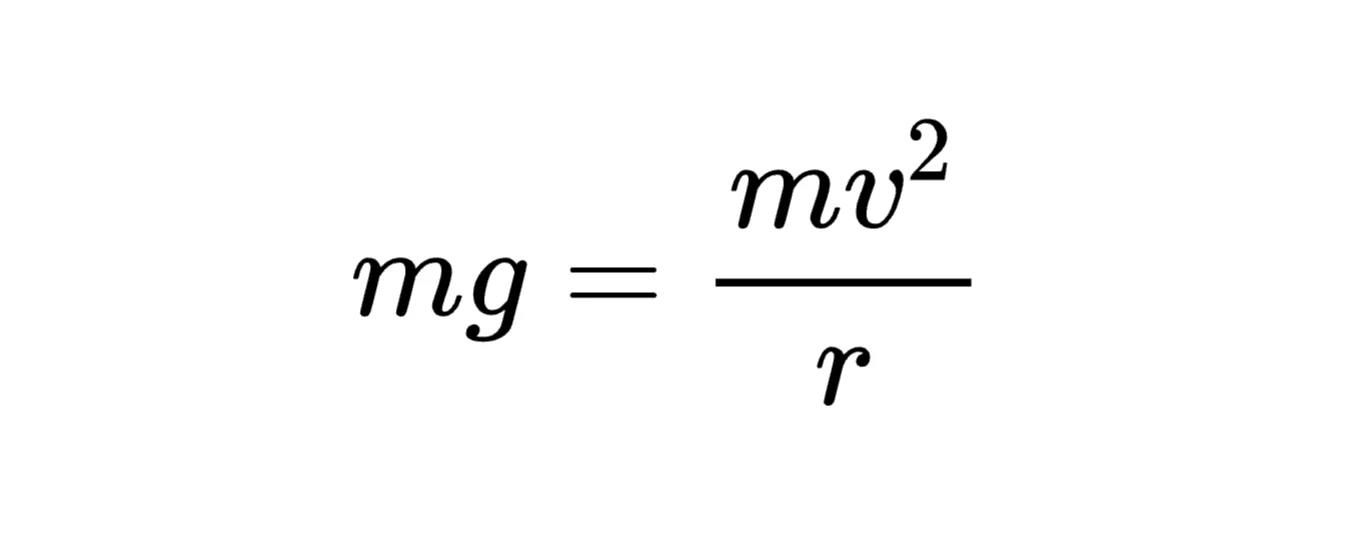
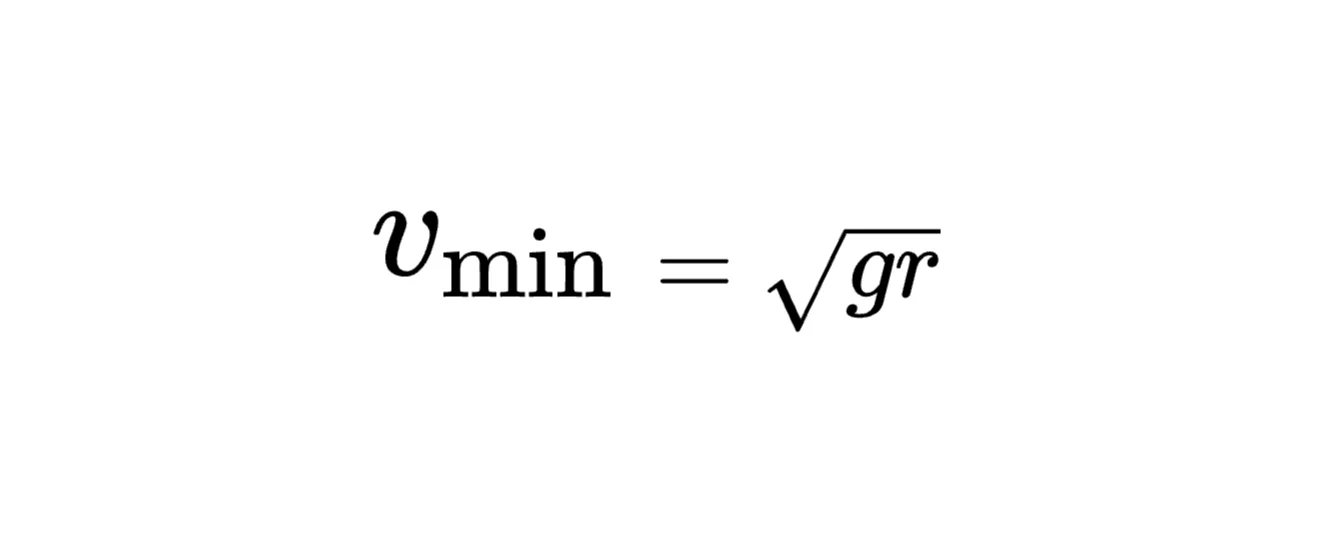
The same value appears in both cases, but for different limiting situations: one is the maximum speed over the outside of a curve, while the other is the minimum speed at the top of an inside loop.
If a situation looks unfamiliar, first write the radial force equation and then apply N = 0 at the point where contact is just lost.
Banked Tracks
For an object moving around a frictionless banked track, the normal reaction acts at an angle.
Its vertical component balances the weight, while its horizontal component acts towards the centre of the circle and provides the centripetal force.
The important physical point is not simply remembering this equation; it is recognising why the normal reaction has a horizontal component and why that component must point towards the centre of the circular path.
The same principle applies to an aeroplane banking during a horizontal turn:
The Key Approach
Most A-Level Physics circular-motion questions follow the same logic:
Identify the centre
Draw the real forces
Resolve towards the centre
Set the resultant equal to mv²/r
The most important idea is not simply remembering the centripetal-force equation; it is recognising which force, or combination of forces, produces the required resultant towards the centre.
Students
Tutors

Narin T
Tutor
Imperial College Engineering Student | A-Level & GCSE Maths and Physics | 50% Off First Lesson



Looking for a tutor?
Sherpa has hundreds of qualified and experienced UK tutors who are ready to help you achieve your goals. Search through our tutors and arrange a free 20 minute introduction through our industry-leading online classroom.
Find a TutorSimilar Articles