
GUEST POST
Why Reading Feels Harder Than Ever - And What to Do About It
Johanna is an English Literature tutor with a BA, MA and PhD in English Literature and over two decades of teaching experience across GCSE, A-Level and undergraduate programmes. Having taught at Goldsmiths, University of London and worked with students on their way to Oxbridge, Ivy League and Russell Group universities.
Here, she reflects on distraction, reading and why the summer is the best time to build the habit back.
Distraction and Reading in Teenagers
By Johanna | English Literature PhD and A-Level Tutor | Sherpa Tutor
It’s hard to read these days.
It’s probably more difficult for teens than for any other group. For all of us beyond childhood, there are endless distractions designed to be precisely that, and focused on the devices that are constantly by our side, if not in our hands!
Our phones beep and ping with messages constantly; we need them to receive school and work information and to check emails; we use them to listen to music, to look up directions and recipes, to check the weather or film times; we use them to do sums, look up definitions and spellings!
We use them to buy things and to book things. We may even use them to buy books, and even to read books. We use them to check the news, which - awhirl around the facts - is a barrage of distractions! And as for social media... I largely quit that around ten years ago. I don’t say that smugly. I know it’s difficult for those who are used to it. But, for a number of reasons, I’m glad I did. It’s hard enough to concentrate as things are.
My reading has reduced over the last few years. I still read plenty, but it often feels like it’s not as easy as it used to be to sit down and read for an afternoon. With all the fuss about Nolan’s The Odyssey this summer, I haven’t picked up the book: I’ve watched podcasts with Homer academics and got into a history podcast which has just taken me through the Romans’ conquest of Britain.
I don’t know what the causal relationships are. I don’t know for sure that screen time in itself reduces our ability to concentrate and to process information in the way that reading a book requires. I absolutely believe social media is designed to keep us hooked. I think that people are reading less now than they were 20 years ago. From my teaching and all the research, it seems incontrovertible that teens are reading less now than they were 20, 30, 40 years ago. And I know from my own experience that reading is an activity which, if practised as a routine, as a habit, helps us to develop our ability to concentrate. I think reading for any sustained time is brain exercise, and as with all physical training - be it football, tennis, dance, or otherwise - it develops the muscle it uses.
So I commit to picking up and holding Homer’s The Odyssey before long, ideal if you’re exploring A-Level English Literature. I may work my way through my book on genetics first, a nice crossover with GCSE Biology, or the autobiography I’ve started, or the book of Chekhov plays I’ve started, which has a rather off-putting cover, or even my Teach Yourself Spanish (handy if you’re taking GCSE Spanish).
Having a choice is a good thing. When I was a child, I loved going to Waterstones. I fell for Point Horror - an American YA series of spooky novels; I loved browsing the shelves and finding the titles I’d not yet read. They had great covers, and pretty great titles. It’s great fun going into a good bookshop and indulging your taste and your imagination. It’s more rewarding than buying a book on your phone, I think, though often more expensive, and it’s much more fun than being told what to read by a teacher.
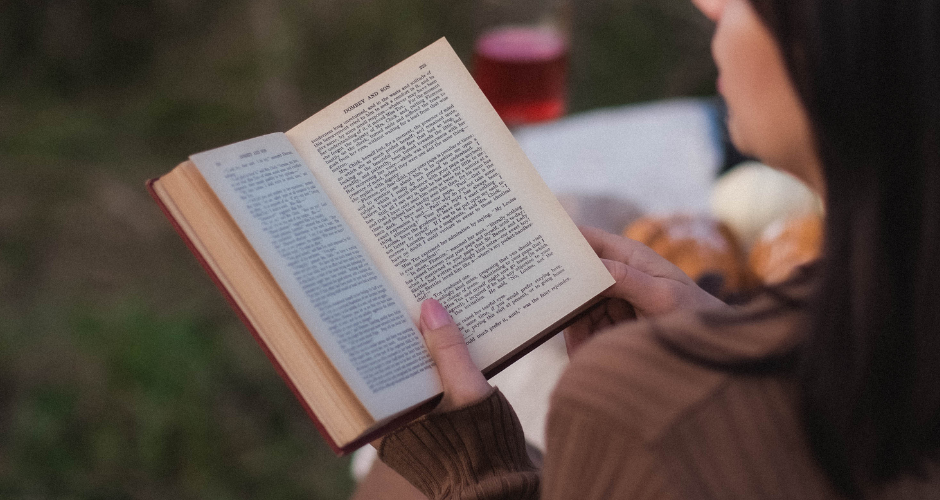
So before this sweltering summer turns into September and term-time, and then autumn, I encourage you to have a roam around your local bookshop, to choose a title or a cover that appeals, to find a comfy spot, and to read without distraction for a while - maybe even without your phone by your side for a while. For I can almost guarantee that doing this will make you want to do it again.
Parents
Students
Johanna O
Tutor
PhD in English Literature & two decades delivering highly successful tutoring



Looking for a tutor?
Sherpa has hundreds of qualified and experienced UK tutors who are ready to help you achieve your goals. Search through our tutors and arrange a free 20 minute introduction through our industry-leading online classroom.
Find a TutorSimilar Articles