

GUEST POST
GCSE English Literature Context Guide: The Strange Case of Dr Jekyll and Mr Hyde

What Do You Need to Know for Jekyll and Hyde GCSE English Exam?
For GCSE English Literature, the five essential context areas for Jekyll and Hyde are: Stevenson's autobiographical background, Victorian London and class division, Victorian values of reputation and morality, scientific anxieties around Darwin's theory of evolution, and Freud's theory of personality (id, ego and superego). All five help explain why Stevenson presents characters and events the way he does.
At first glance, The Strange Case of Dr Jekyll and Mr Hyde might seem like any detective fiction of its time: an investigation into a strange, gothic and inexplicable happening, set against the gloomy backdrop of Victorian London. But in fact, the novel goes far beyond simple detective fiction.
The Victorians had plenty of beliefs about what made people 'good' or 'evil', and in this novel Robert Louis Stevenson taps into something primal about human nature – a capacity for evil that resides in us all.
The novel is still culturally relevant today because of the way it addresses humanity's concerns about morality and science. In this guide, we will consider the social, cultural and scientific context that underpins the novel, and how to link to it effectively in your GCSE English essays.
Whether you are revising independently or working with a GCSE English tutor, understanding the context behind the novel is what separates a descriptive response from a genuinely analytical one – and it is where online tuition can make the biggest difference, helping you practise linking these ideas to specific quotations under exam conditions.
Here is a quick-reference summary of all five context areas before we look at each in depth:
| Context Area | Key Idea | Link to the Novel |
|---|---|---|
| Autobiographical | Stevenson's Presbyterian upbringing and childhood nightmares shaped his interest in morality and the darker side of human nature | The novel's exploration of repression and hidden desires reflects Stevenson's own complex relationship with religion and morality |
| Victorian London | The city was divided between rich and poor, with reputation essential to those in the upper classes | The contrast between Jekyll's lavish home and Hyde's sinister door reflects the physical and moral divide in Victorian society |
| Good and Evil | Victorians placed enormous value on reputation and the appearance of a respectable, Christian life | Jekyll's need to suppress his darker desires mirrors the pressure Victorian men felt to maintain a respectable public image |
| Scientific anxiety | Darwin's theory of evolution caused fears of 'devolution' — that humans might revert to a primitive state | Hyde's ape-like description directly echoes these Victorian anxieties about regression and the loss of civilisation |
| Freud's theory | The personality can be split into the id (dark desires), ego (rational balance), and superego (moral reputation) | Jekyll is the superego, Hyde is the id — and their conflict shows what happens when the ego loses its ability to balance them |
If you are also revising other GCSE English Literature texts, our context guides for An Inspector Calls and A Christmas Carol follow the same structure and are worth reading alongside this. For top-grade essay technique across all Literature texts, see our guide on how to get a Grade 9 in GCSE English Literature.
1. Autobiographical Context: Robert Louis Stevenson
Robert Louis Stevenson was a novelist, poet, essayist and travel writer, most famous for Treasure Island and The Strange Case of Dr Jekyll and Mr Hyde. He was born in 1850 in Edinburgh, Scotland, to middle-class Presbyterian parents.
Presbyterianism is a branch of Christianity focused on Calvinist beliefs, and Stevenson was said to have suffered from nightmares as a child as a result of these beliefs, showing a scepticism towards religion from a young age. He experienced lung problems throughout his childhood and spent much of his youth being tutored at home, where he discovered a passion for story writing.
As Stevenson got older, he travelled extensively: his lung problems attracted him to warmer destinations for relief from his symptoms. His travels provided the basis for Treasure Island in 1883. The Strange Case of Dr Jekyll and Mr Hyde followed shortly after, and the 1880s marked a period of great critical success – he was praised by other noted writers of the time, including Henry James and J.M. Barrie. He died from a brain haemorrhage in Samoa in 1894, aged just 44.
Exam tip: Stevenson's Presbyterian upbringing is directly relevant to the novel's treatment of sin, guilt and the suppression of desires. His personal experience of keeping secrets – his own health, his unconventional views on religion – feeds directly into Jekyll's double life.
2. Victorian London: The Perfect Setting
Although Stevenson spent much of his adult life in London, the Gothic influence of Scottish architecture never quite left him. Many scholars observe that the London presented in the novel feels much like Edinburgh and its dark, grey streets. Stevenson may also have been inspired by the story of Deacon William Brodie – a city councillor in Edinburgh who led a double life as a burglar to support his mistresses and gambling addiction.
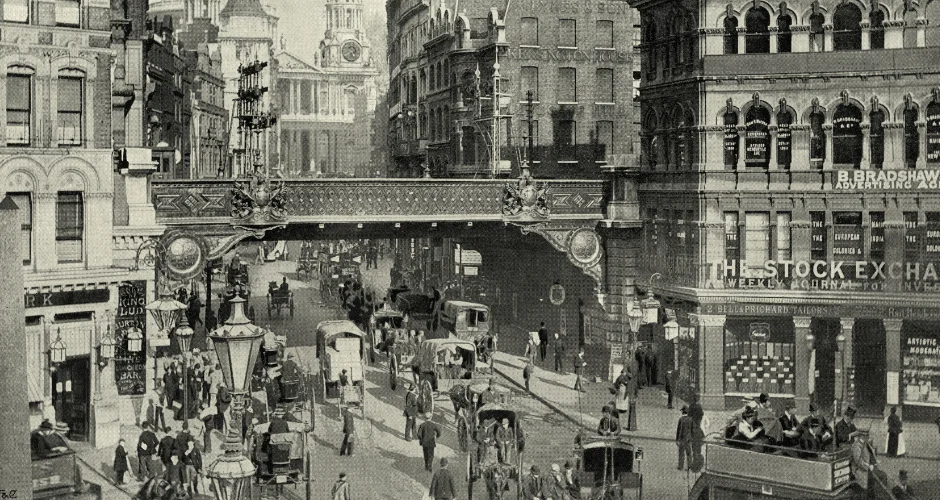
London was the central city of the Industrial Revolution, and the experiences of living there were massively different for the rich and the poor. The rapid movement of people from the countryside into the city meant the population was dense, with little to physically separate the wealthy from those in poverty. We see this from the very beginning of the novel, where a bright commercial setting is quickly disrupted by a building with a sinister-looking door.
The poor lived in buildings like these, sharing cramped space with other families, which led to the spread of diseases such as cholera. The rich, by contrast, were more likely to be found enjoying lavish dinner parties – as Dr Jekyll does throughout the novel.
Understanding Victorian London is one of the areas where working with a GCSE English tutor can make a significant difference. A tutor can help you see exactly how the setting functions as a symbol throughout the text, rather than treating it as background detail.
3. 'Good' and 'Bad' in Victorian England
Reputation was highly valued by Victorians – particularly those in the upper classes. It was essential to appear to lead a decent, Christian life, and manners, dress and conduct all had to meet society's strict expectations. Among the more privileged, stereotypes arose about the poor, depicting them as brutish, badly behaved and dangerous.
Prime Minister Benjamin Disraeli wrote about London being split into 'Two Nations', with the rich and poor sections of society having completely different communities and values. That said, Victorian men of all classes were liable to lead double lives, having extramarital affairs with mistresses, or indulging in drinking, gambling and prostitution. Sexually transmitted diseases like syphilis spread through the population and gave men and their secrets away.
| Victorian Value | How It Manifests in Society | How Stevenson Challenges It |
|---|---|---|
| Reputation | A gentleman's public image was everything — scandal was social ruin | Utterson protects Jekyll's reputation even as Hyde commits crimes, showing how reputation takes priority over morality |
| Christian morality | Appearing to lead a decent, God-fearing life was socially essential | Jekyll's scientific experiments transgress what was considered God's domain, echoing fears about science vs religion |
| Class division | The poor were stereotyped as brutish and dangerous; the rich as civilised and virtuous | Hyde embodies the fears upper-class Victorians had about the poor — yet he is born from a wealthy, respected man |
| The double life | Men of all classes secretly indulged in drinking, gambling and extramarital affairs | Jekyll's need to create Hyde to act on his desires reflects the reality of Victorian hypocrisy beneath respectable surfaces |
"Stevenson uses Hyde's association with the sinister door in a run-down part of London to connect evil with the lower classes, reflecting Victorian stereotypes about poverty and moral corruption. However, Hyde emerges from Jekyll – a wealthy, respected gentleman – suggesting that Stevenson is deliberately challenging these comfortable assumptions."
For more on how to structure this kind of analytical point, our post on using the PACCT method for analysing English Literature gives a reliable framework for building responses that connect context, quotation and analysis in a single, focused paragraph.
4. Scientific Anxieties: Darwin and the Fear of Devolution
The Strange Case of Dr Jekyll and Mr Hyde was first published in 1886, around thirty years after Charles Darwin published On the Origin of Species in 1859. Darwin's theory of evolution proposed that all species had changed over time, with only those having the most well-adapted traits surviving – and, controversially, that human beings had evolved from apes.
Evolution is widely accepted today, but it was deeply controversial at the time. Christians were reluctant to accept that any of God's creatures could be imperfect, die out, or need to adapt to survive. Darwin's theory also sparked fears of 'devolution': the idea that humans might revert to a more primitive state. We see echoes of this directly in Mr Hyde's often ape-like physical description.

The theory of evolution was just one of many unsettling scientific developments of the Victorian era. Others included the telegraph, telephone, lightbulb and camera. People felt simultaneously excited and anxious about these changes, with some fearing that science might turn humanity away from God. These anxieties are reflected directly in the novel – the 'mad scientist' trope became a common literary device for exploring exactly these concerns, and Dr Jekyll's experiments embody this perfectly.
"Stevenson describes Hyde as having something 'troglodytic' in his appearance, evoking the Victorian fear of devolution following Darwin's theory of evolution. This suggests that when Jekyll removes his moral restraint, what emerges is not just evil, but something primitive and pre-civilised, reflecting Stevenson's critique of the idea that social respectability makes men truly good."
If you find scientific context difficult to apply in essays, this is one of the areas where online tuition can help most – working through exactly how to connect a historical idea to a specific quotation is a skill that improves quickly with guided practice.
5. Freud's Theory of Personality
Born in 1856, Sigmund Freud was an Austrian psychiatrist widely regarded as the founding father of psychoanalysis. Although Freud's key works were published after the novel, his theories provide a useful framework for understanding the Victorian concerns about behaviour and personality that Stevenson was already exploring.
Freud theorised that our personalities could be split into three parts: the superego, ego and id. These components help explain why 'good' people can do 'bad' things.
| Part of Personality | What It Represents | Who It Maps to in the Novel |
|---|---|---|
| The Superego | The part of the personality concerned with reputation and being perceived as good | Dr Jekyll — flawless surface appearance, respected by society, obsessed with his reputation |
| The Id | The repressed, dark and unconscious desires of the personality | Mr Hyde — acts on every impulse without moral restraint, committing atrocities Jekyll would never admit to |
| The Ego | The rational part that balances the id and superego — keeps behaviour in check | When Jekyll loses control of the ego, Hyde takes over entirely — the ego's collapse is what drives the tragedy |
In Freudian theory, we all have each of these parts – we are just lucky to be able to balance them effectively through the ego. When Jekyll loses that balance, Hyde takes over entirely. This is Stevenson's key point: Hyde is not a separate being. He is Jekyll. The horror of the novel is not that evil exists out there – it is that it exists within all of us.
Exam tip: note that Freud's major works were published after the novel. Do not claim Stevenson was directly influenced by Freud. Instead, say that Freud's theory helps us understand the Victorian anxieties about dual personality and repression that Stevenson was already exploring.
"Stevenson's presentation of Jekyll as a man of flawless public reputation who secretly indulges his darker urges through Hyde reflects Freudian ideas about the conflict between the superego and the id. Although Freud published his key theories after the novel, Stevenson was drawing on the same Victorian anxieties about repression that Freud later sought to explain – suggesting that the struggle between respectability and desire was a defining psychological concern of the age."
6. How to Use Context in Your Essays
The same principle applies here as with any GCSE English Literature text: context is not a separate history paragraph. It is the reason Stevenson presents characters and events the way he does.
The most effective technique is one short, precise context point, directly linked to a character, quotation or theme. A useful sentence frame:
"This reflects the context of... because... Stevenson uses this to show his [Victorian/contemporary] audience that..."
You do not need every context point in every essay. Identify the one or two that fit the specific question and weave them in at the moment they are most relevant, not as a lump at the start.
For more on how to write the essay itself, see our guides on how to write an analytical GCSE English essay and writing a great essay in six simple steps. Our post on how to create an English Literature revision cheatsheet is also useful for condensing your context notes into something you can review quickly before the exam.

Conclusion
The Strange Case of Dr Jekyll and Mr Hyde is a novel rich with context at every level – from the autobiographical to the scientific to the psychological. The students who score highest are not the ones who know the most facts about the Victorians. They are the ones who connect those facts to specific moments in the text, most precisely and concisely.
Every context point in this guide is a tool. Use it to explain why Stevenson made a specific choice – and your essays will become significantly stronger.
If you would like support working through Jekyll and Hyde with an experienced GCSE English tutor, Sherpa's tutors can help you develop your AO3 skills with direct feedback on how to link context to quotations effectively.
Whether you are targeting a Grade 5 or pushing for a Grade 9, online tuition gives you the kind of focused, personalised practice that makes the difference in timed exam conditions.
Parents
Students
Tutors

Luke H
Tutor
Master of Arts student with 4+ years of GCSE tutoring experience



Looking for a tutor?
Sherpa has hundreds of qualified and experienced UK tutors who are ready to help you achieve your goals. Search through our tutors and arrange a free 20 minute introduction through our industry-leading online classroom.
Find a TutorSimilar Articles
The UK Education System | A Guide to British Schools
Welcome to the ultimate guide on the UK education system.
James Gurnett
24th April