

GUEST POST
The Hardest A-Level Maths Topics (And How to Master Them)

Fei is specialist Maths Tutor who covers GCSE Maths, A-Level Maths as well as A-level Further Maths, having completed a Ph.D in Actuarial Maths and qualified as an actuary.
He has taught hundreds of students from the country's most competitive schools to help them achieve top grades and prepare them for the most difficult admissions tests.
5 Topics Where A-Level Maths Students Lose the Most Marks
By Fei Y | GCSE, A-Level and Degree Level Maths Tutor | Sherpa Tutor
A-Level Maths is a big step up from GCSE. Most students expect the content to become harder, but the real challenge is often more subtle: the questions stop telling you exactly what to do. At GCSE, many questions are quite procedural. At A-Level, students are expected to choose methods, link topics together, interpret wording carefully, and present their reasoning clearly.
In this article, I will look at 5 A-Level Maths topics that students consistently find difficult: integration, vectors, trigonometry, mechanics, and hypothesis testing. For each one, I will explain why it causes problems, what examiners usually want to see, and how students can approach the topic more effectively, using an example from past papers.
1. Integration: Choosing the Right Method
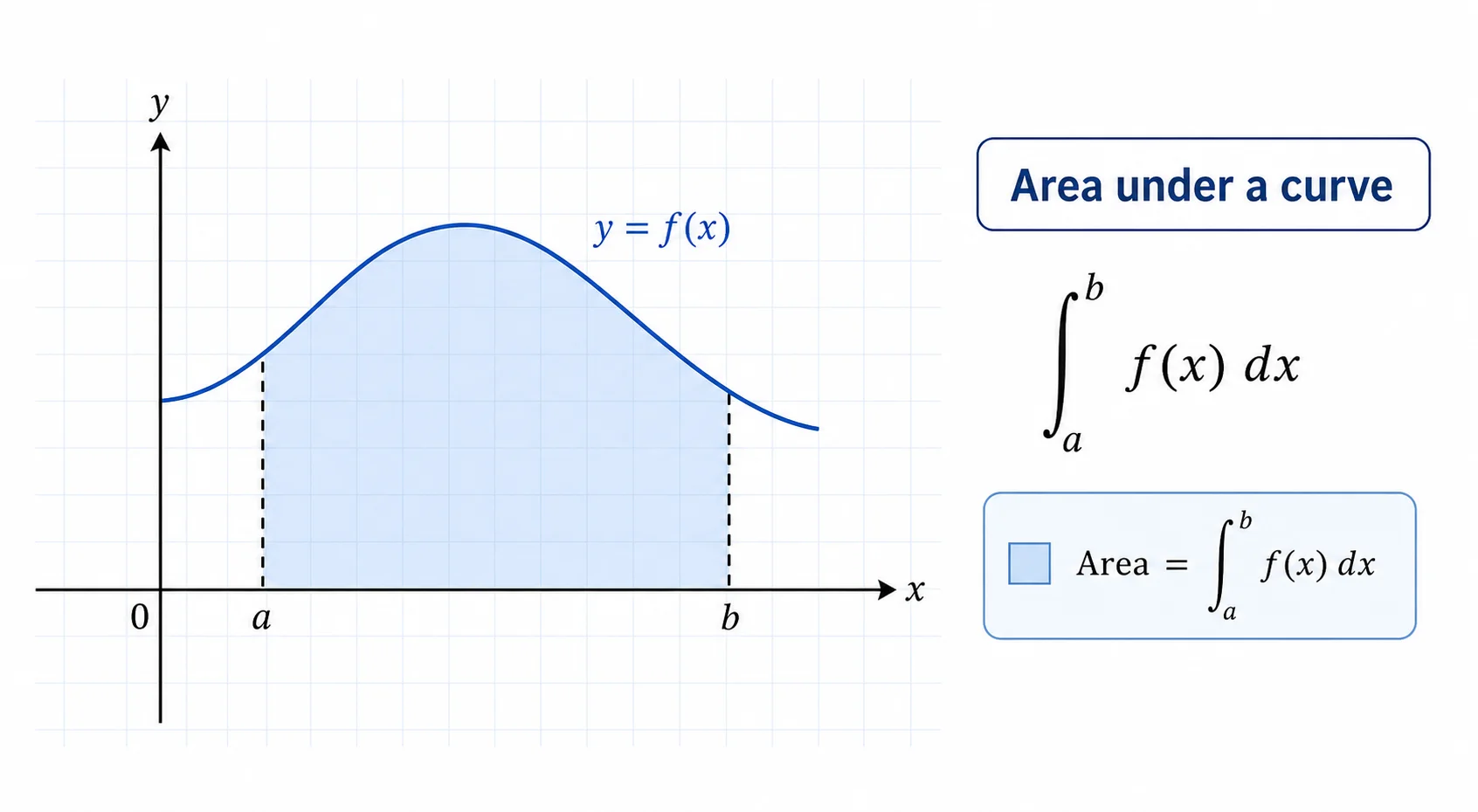
Integration is one of the first topics where A-Level Maths students realise that knowing the rules is not enough.
The most common difficulty is not the calculation itself, but recognising which method fits. Is it standard integral, substitution, integration by parts, partial fractions, or a trigonometric identity? Students can revise each technique separately and still freeze when they meet a mixed question in an exam.
Worked example: integration by parts
Find:
∫ x e^x dx
For this question, the product of x and e^x suggests integration by parts.
Use:
∫ u dv/dx dx = uv - ∫ v du/dx dx
Choose:
u = x, so du/dx = 1
dv/dx = e^x, so v = e^x
Therefore:
∫ x e^x dx = x e^x - ∫ e^x dx
= x e^x - e^x + C
= e^x(x - 1) + C
What students often get wrong
A common mistake is choosing u = e^x and dv/dx = x. This still can work, but it makes the expression more awkward rather than simpler. Examiners want to see that the chosen method reduces the problem. With integration by parts, a good choice of u should usually become simpler when differentiated.
Another common mistake is forgetting the constant of integration. In a one-mark step, this may seem minor, but in A-Level Maths it shows whether the student understands that indefinite integration gives a family of functions.
How to master integration
Students should practise identifying the type of integral before doing any working. A useful exercise is to look at a page of mixed integration questions and, without solving them, write down the likely method next to each one. This builds the decision-making skills that exam questions are really testing.
An A-Level Maths tutor can be especially helpful here because a tutor can ask, “Why that method?” rather than simply checking the final answer. That kind of questioning trains students to spot patterns, which is often the difference between knowing how to integrate and being able to use it under exam pressure.
2. Modulus Functions: Understanding Distance From Zero
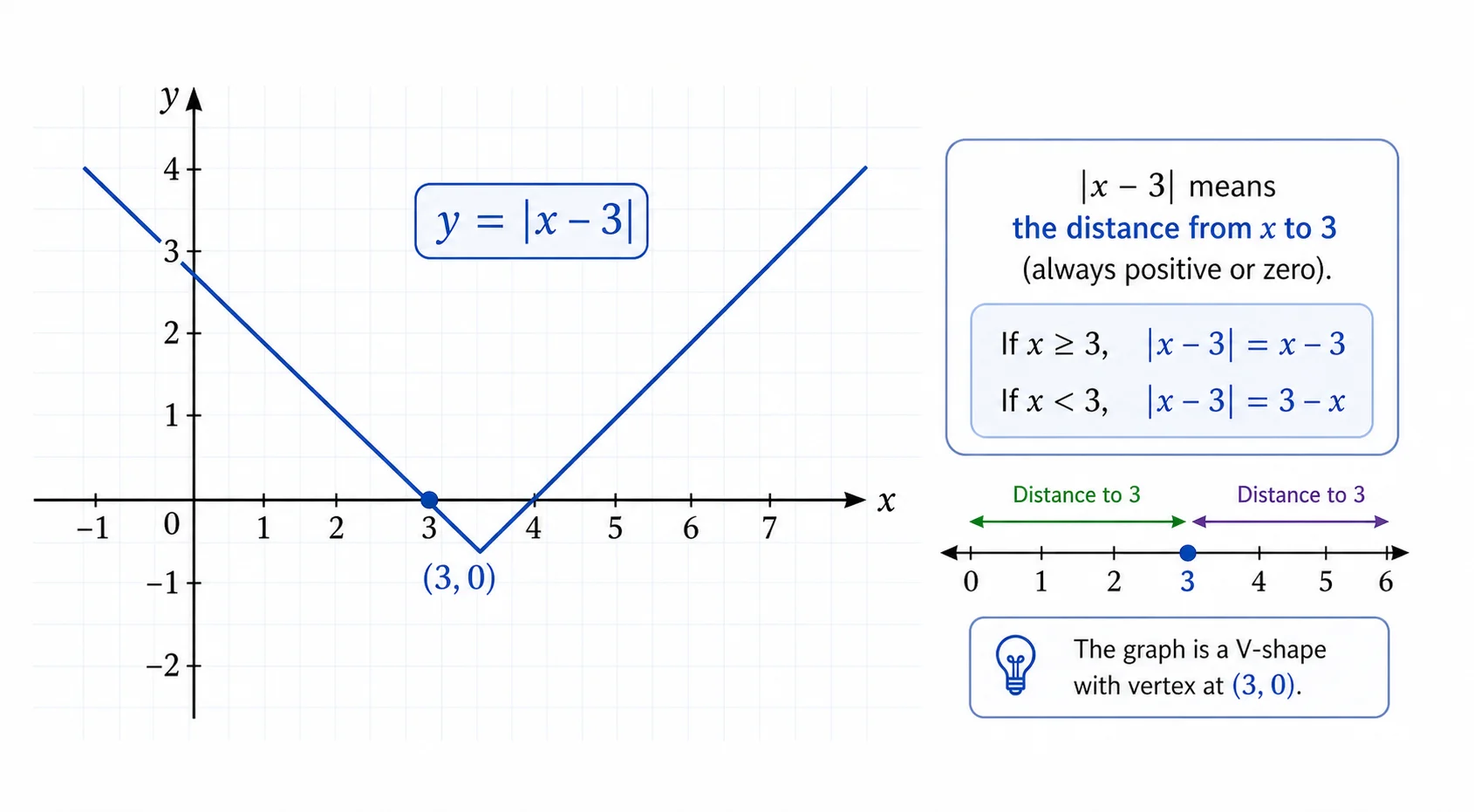
Modulus functions are often underestimated because the notation looks simple, but questions can become difficult quickly as they require students to think about distance, graphs, transformations and inequalities at the same time.
The key idea is that |x| means the distance of x from zero. So |5| = 5 and |-5| = 5. The difficulty comes when the expression inside the modulus is more complicated, such as |x - 3| or |2x + 1|. Students need to understand these as distances from a point, not simply 'make everything positive'.
Worked example: solving a modulus equation
Solve: |x - 3| = 5
This means the distance between x and 3 is 5. So there are two possibilities:
x - 3 = 5 or x - 3 = -5
Solving each equation:
x = 8 or x = -2
Therefore, the solutions are:
x = 8 or x = -2
What students often get wrong
A common mistake is to only solve x - 3 = 5 and forget x - 3 = -5. This loses one of the two possible solutions. Modulus equations usually require students to consider both the positive and negative cases, unless the question has restrictions that remove one of them.
Another mistake is treating |x - 3| as |x| - 3. This is not correct. The modulus applies to the whole expression inside the bars. This distinction becomes especially important when sketching graphs or solving inequalities.
Graphing modulus functions
Graphs are where many students start to struggle with modulus. For example, the graph of y = |x - 3| is a V-shaped graph with its minimum point at x = 3. This is because x - 3 is zero when x = 3, so |x - 3| is smallest there.
One useful way to think about it is:
if x >= 3, then |x - 3| = x - 3
if x < 3, then |x - 3| = -(x - 3) = 3 - x
This piecewise approach helps students understand why the graph changes direction at x = 3.
What examiners want to see
Examiners want to see that students understand the two-sided nature of modulus.
For equations, this usually means considering two cases. For inequalities, it means interpreting the modulus as a distance or converting it into a compound inequality.
For graph questions, examiners want accurate turning points and correct reflection of negative parts of the graph.
If a question asks for the graph of y = |f(x)|, the parts of y = f(x) below the x-axis should be reflected above the x-axis. Students often lose marks by shifting the whole graph incorrectly instead of reflecting only the negative section.
How to master modulus
Students should practise translating modulus into words before solving. For example, |x - 3| = 5 means “x is 5 units away from 3”. This simple sentence often makes the algebra much clearer.
It also helps to sketch a number line or graph before solving harder questions. Modulus is a visual topic, and students who try to do everything symbolically can miss the meaning of the expression.
An A-Level Maths tutor can be particularly useful here because modulus mistakes often come from a small misconception that gets repeated across equations, inequalities and graphs. Once students understand modulus as distance, the topic becomes much more logical and much less mysterious.
3. Vectors: Turning Algebra Into Geometry
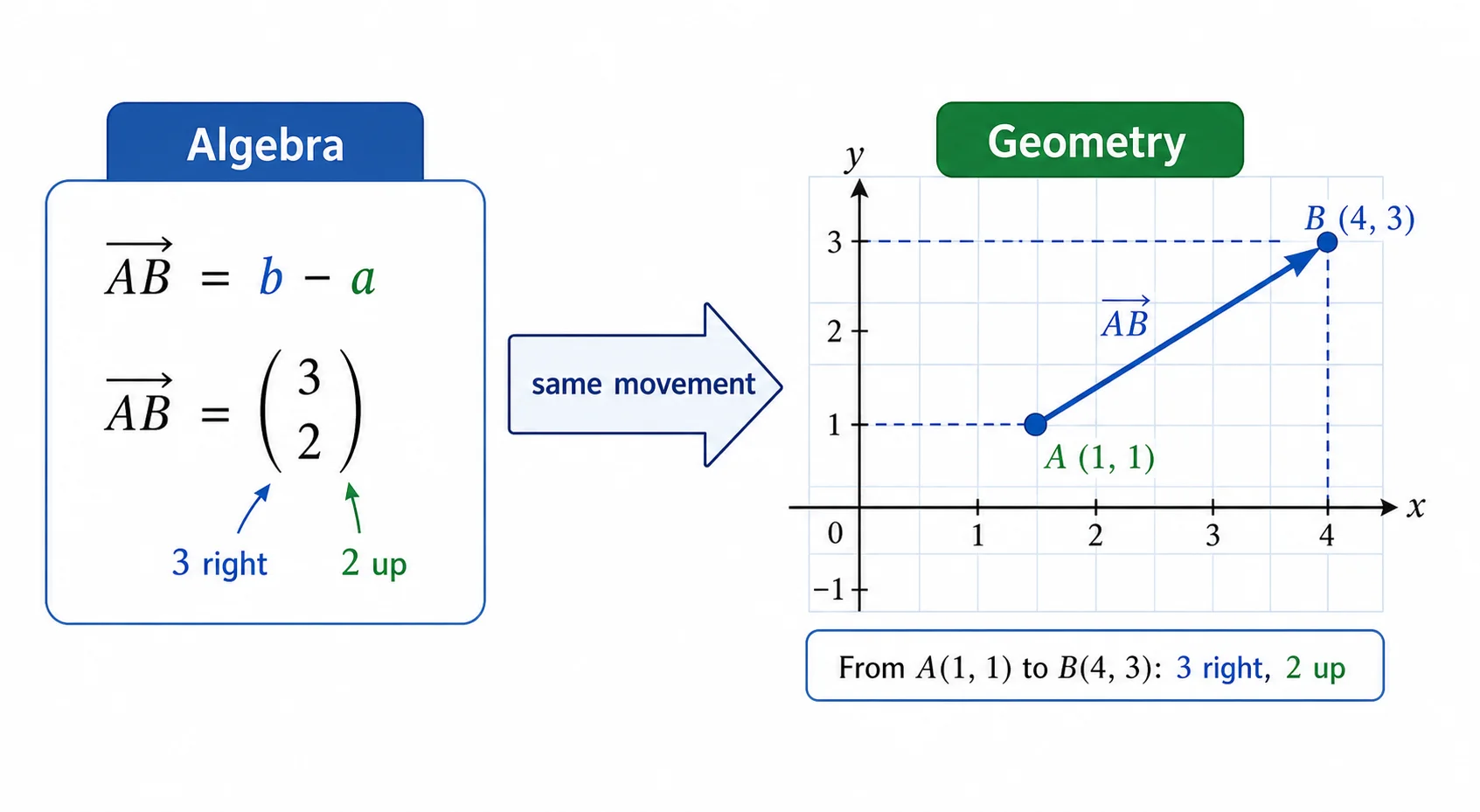
Vectors are difficult because they sit between algebra and geometry. Students may be able to calculate with vectors, but the hardest questions often ask them to prove something geometric: that two lines are parallel, that three points are collinear, that a point lies on a line, or that two vectors are perpendicular.
The key idea is that vectors describe movement. If students only treat them as columns of numbers, the topic becomes mechanical and confusing. They need to keep asking: what does this vector represent in the diagram?
Worked example: proving points are collinear
Points A, B and C have position vectors:
a = 2i + j
b = 5i + 7j
c = 8i + 13j
Show that A, B and C are collinear.
First find AB: AB = b - a = (5i + 7j) - (2i + j) = 3i + 6j
Now find BC: BC = c - b = (8i + 13j) - (5i + 7j) = 3i + 6j
Since AB = BC, the vectors are parallel and connected end-to-end. Therefore, A, B and C lie on the same straight line.
What examiners want to see
For a collinearity proof, it is not enough to say the coordinates “look like they are in a line”. Examiners want a clear vector argument. The student needs to show that one displacement vector is a scalar multiple of another, or in this case, equal to another. The conclusion should be written in words: therefore, the points are collinear.
What students often get wrong
Students often calculate the vectors correctly but do not finish the proof. In A-Level Maths, the final explanatory sentence matters. If the question asks “show that”, the examiner is looking for a chain of reasoning, not just a calculation.
Another common issue is subtracting vectors in the wrong order. AB means b - a, not a - b. Drawing a quick arrow from A to B is the proper notation and can prevent this mistake.
How to master vectors
The best way to improve at vectors is to connect every calculation to a diagram. Even a rough sketch helps students understand what the algebra is doing. When revising, students should practise writing short explanations after their calculations, because many vector marks are awarded for reasoning rather than arithmetic.
Online tuition can work very well for vectors because diagrams can be built step by step on a shared whiteboard. A tutor can watch where the student places the arrows and correct the misconception before it becomes a repeated exam habit.
4. Mechanics: Modelling Before Calculating
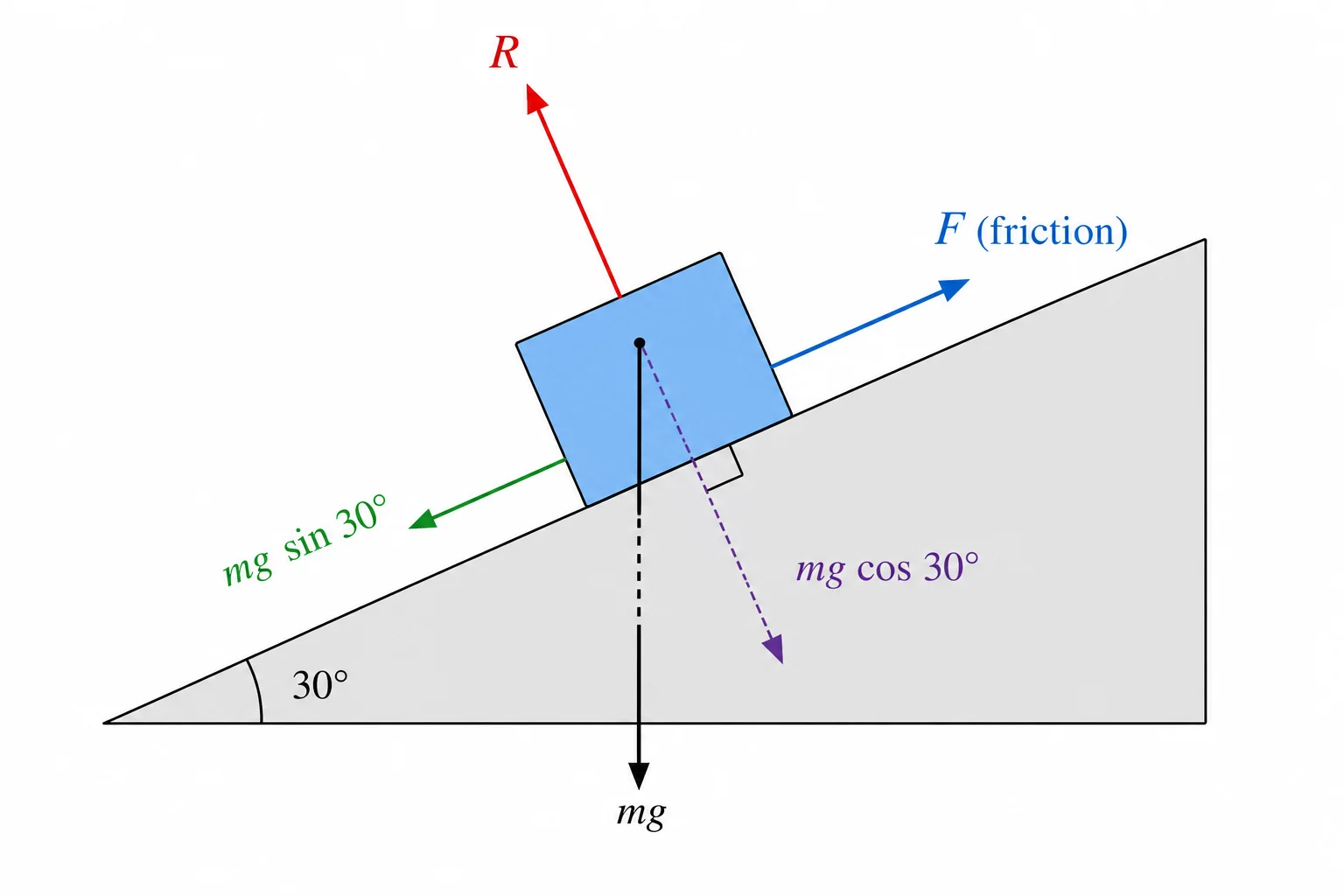
Mechanics can be frustrating for students who are otherwise strong at pure maths. The algebra is often manageable, but the hard part is setting up the model correctly. The most common mistake is rushing into formulae. Students see acceleration, time or force and immediately search for an equation.
Examiners reward the modelling stage: drawing a diagram, resolving forces in the correct direction, stating assumptions and choosing signs consistently. Students who skip this and work through the calculation in their heads risk producing incomplete working that loses marks even when the approach is correct.
Worked example: resolving forces on an inclined plane
A particle of mass 4 kg rests on a rough plane inclined at 30 degrees to the horizontal. Find the component of its weight acting down the plane.
Weight acts vertically downwards and has magnitude:
mg = 4g
The component down the plane is:
4g sin 30 degrees = 4g x 1/2 = 2g N
Using g = 9.8, this is:
2g N = 19.6 N
What students often get wrong
Many students use cos 30 degrees instead of sin 30 degrees. This is usually not because they do not know trigonometry, but because they have not drawn the force diagram carefully enough. The angle in the force triangle needs to be understood, not guessed.
Another common mistake is leaving out units. In mechanics, units are part of the modelling. A final answer of 19.6 is incomplete unless it is clear that the answer is a force measured in newtons.
What examiners want to see
Examiners want a clear diagram or a clear statement of the resolved component. If friction is involved, they want to see the friction force acting in the correct direction. If Newton’s second law is used, they want to see a consistent equation such as F = ma in a chosen direction.
Mechanics is one of the topics where a presentation can directly improve marks. An answer reached through unclear work is risky because a small sign error can make the whole solution difficult to follow.
How to master mechanics
Students should build a routine: draw the diagram, mark the forces, choose a positive direction, then write the equation. This may feel slow at first, but it saves time by preventing confused algebra.
This is also where an A-Level Maths tutor can make a big difference. A tutor can help students talk through the physical situation before writing any equations. That conversation is often what students miss when they revise alone: they can check whether the model makes sense before they commit to the calculation.
5. Hypothesis Testing: Knowing What The Result Actually Means
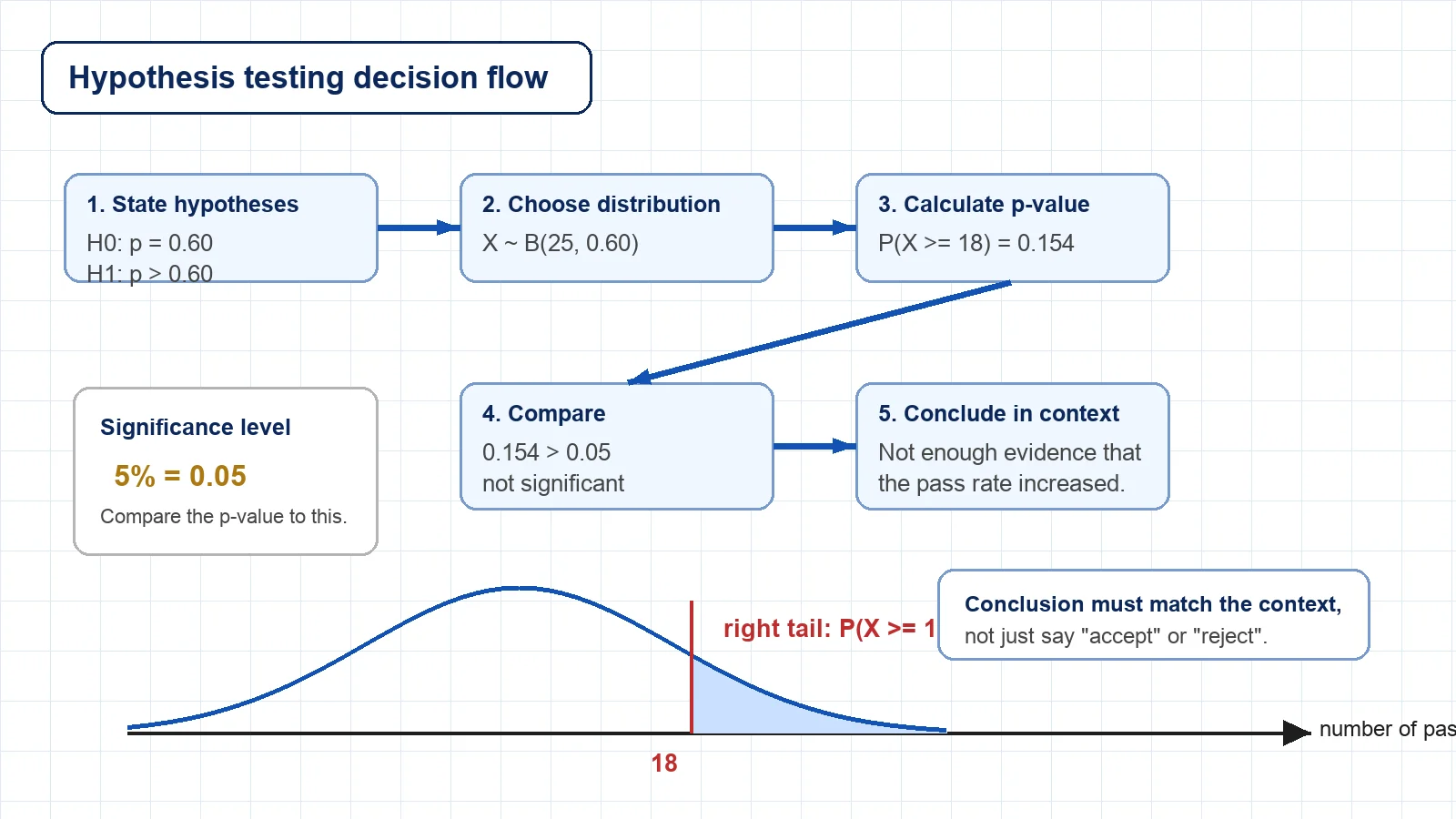
Hypothesis testing is one of the statistics topics students find surprisingly difficult. The calculations are usually not the hardest part. Unlike pure maths, where students find an exact answer, hypothesis testing requires making a decision based on evidence and probability, so the wording of the question matters enormously.
The key idea is that a hypothesis test starts with the null hypothesis H0, representing the 'no change' position, and an alternative hypothesis H1. For example, to test whether a 60% pass rate has improved:
H0: p = 0.60
H1: p > 0.60"
Here, p represents the true proportion of students who pass. The alternative hypothesis is p > 0.60 because we are testing whether the pass rate has increased.
Worked example: a binomial hypothesis test
A school claims that 60% of students pass a practice paper. After a new revision programme, 18 out of 25 students passed the test, at the 5% significance level, is there evidence that the pass rate has increased?
Let X be the number of students who pass out of 25. Under H0:
X ~ B(25, 0.60)
The hypotheses are:
H0: p = 0.60
H1: p > 0.60
We need to calculate the probability of getting 18 or more passes, assuming the true pass rate is still 0.60 (60%):
P(X >= 18)
Using a calculator:
P(X >= 18) = 1 - P(X <= 17) ≈ 0.154
Since 0.154 is greater than 0.05, the result is not significant at the 5% level. Therefore, there is not enough evidence to conclude that the pass rate has increased.
What students often get wrong
One common mistake is writing the conclusion too strongly. A hypothesis test does not prove that the pass rate has not increased. It only says that the sample does not provide enough evidence at the chosen significance level. This distinction matters because examiners expect careful statistical language.
Another common mistake is using the wrong tail. In the example above, the alternative hypothesis is p > 0.60, so we look at the upper tail: the probability of getting 18 or more passes. If the question asked whether the pass rate had changed, rather than increased, a two-tailed test would be needed.
Students also sometimes compare the wrong probability with the significance level. The p-value must match the direction of the alternative hypothesis. If the alternative is “greater than”, the relevant probability is the probability of getting a result at least as high as the observed one.
What examiners want to see
Examiners want a clear sequence of reasoning. A good hypothesis-testing answer should include:
- The definition of the random variable.
- The distribution being used.
- The null and alternative hypotheses.
- The relevant probability or critical region.
- A comparison with the significance level.
- A conclusion written in the context of the question.
The context is especially important. A final sentence such as “reject H0” may not be enough on its own. A stronger answer would say something like: “There is sufficient evidence at the 5% significance level that the pass rate has increased.”
How to master hypothesis testing
Students should practise reading the wording of the question before doing any calculations. The phrase “has increased” points to a one-tailed test with H1: p > something. The phrase “has decreased” points to H1: p < something. The phrase “has changed” usually points to a two-tailed test.
It also helps to separate the method from the interpretation. First, students should set up the test correctly. Then they should calculate the probability. Finally, they should translate the result back into ordinary language.
An A-Level Maths tutor can be very useful for hypothesis testing because many errors are not arithmetic errors; they are interpretation errors. A tutor can help students explain what their conclusion actually means, which is exactly the skill examiners are testing in statistics questions.
Final Advice
“Hard topics become easier when students learn the thinking behind them”
The hardest A-Level Maths topics are not always the ones with the longest formulae. They are the ones where students have to make decisions. That is why simply doing more questions is not always enough. After each question, students should ask:
- What was the clue that pointed to the method?
- Where could I have lost marks?
- Did I explain my reasoning clearly enough for an examiner?
- What would change if the numbers or wording were slightly different?
For students who feel stuck, working with an A-Level Maths Tutor can help identify exactly where understanding breaks down and give them the required attention. Whether that is algebra fluency, exam technique, or confidence. With clear methods, careful working and targeted support, students can turn these problem areas into some of their strongest parts of the course.
Parents
Students

Fei Y
Tutor
I am Teaching GCSE and A Level Maths



Looking for a tutor?
Sherpa has hundreds of qualified and experienced UK tutors who are ready to help you achieve your goals. Search through our tutors and arrange a free 20 minute introduction through our industry-leading online classroom.
Find a TutorSimilar Articles


