

GUEST POST
GCSE English Literature Context Guide: Macbeth

What Do You Need to Know for Macbeth GCSE English Exam?
For GCSE English Literature, the six essential context areas for Macbeth are: James I and the Divine Right of Kings, the Gunpowder Plot and fears of treason, Jacobean beliefs about witchcraft and the supernatural, gender expectations in the early seventeenth century, ambition and moral responsibility, and the restoration of order through legitimate kingship. All six inform how and why Shakespeare presents characters, themes and events the way he does.
Shakespeare opens Macbeth by placing the audience into what he calls an 'upside down' world, not unlike the distorted reality of the Upside Down in Stranger Things, where moral boundaries are blurred and appearances cannot be trusted. 'Fair is foul, and foul is fair.' From the very first scene, nothing is as it seems.
Written in 1606 during the reign of King James I, Macbeth reflects contemporary anxieties about political power, witchcraft and the fragility of social order. Understanding the historical and cultural context allows us to see that Shakespeare was not simply telling a story about ambition and murder, but exploring deeper fears about kingship, fate and the supernatural that his audience would have felt with urgency.
Whether you are working through Macbeth independently, using online tuition to prepare for your exams, or studying with a GCSE English tutor, understanding context is what lifts a descriptive response into genuine analysis. Here is a quick-reference summary of all six context areas before we look at each in depth:
| Context Area | Key Idea | Link to the Play |
|---|---|---|
| James I and Divine Right | James I believed kings were appointed by God — killing a king was both a political crime and a religious sin | Duncan's murder disrupts nature itself, shown through horses eating each other and unnatural darkness — regicide is cosmic disorder |
| The Gunpowder Plot | The 1605 plot to assassinate James I created widespread fear of treason and conspiracy | Macbeth's treachery would have felt urgent and relevant to contemporary audiences still shaken by the Plot |
| Witchcraft | James I wrote Daemonologie (1597) and believed witches were real threats — supernatural belief was widespread | The witches' influence raises the central question: is Macbeth responsible for his actions, or are darker forces at work? |
| Gender expectations | Men were expected to be decisive and courageous; women obedient and morally virtuous | Lady Macbeth rejects femininity to pursue power, but is ultimately destroyed by guilt — suggesting moral violation cannot be sustained |
| Ambition and moral responsibility | Ambition is not inherently evil, but becomes destructive when unchecked by morality | Each murder Macbeth commits leads only to paranoia and further violence — power gained immorally must be defended immorally |
| Restoration of order | Legitimate kingship must be respected; rebellion against rightful rulers will ultimately fail | Malcolm's return restores order — but the circular structure suggests the conditions for tyranny may always return |
This is part of our GCSE English Literature context series. If you are revising other set texts, our guides for An Inspector Calls, A Christmas Carol and Jekyll and Hyde follow the same structure. For top-grade essay technique, see our guide on how to get a Grade 9 in GCSE English Literature.
1. James I and the Politics of Kingship
One of the most important influences on Macbeth was the reign of James I, who became King of England in 1603. In 1606, the political stability of the monarchy was a major concern.
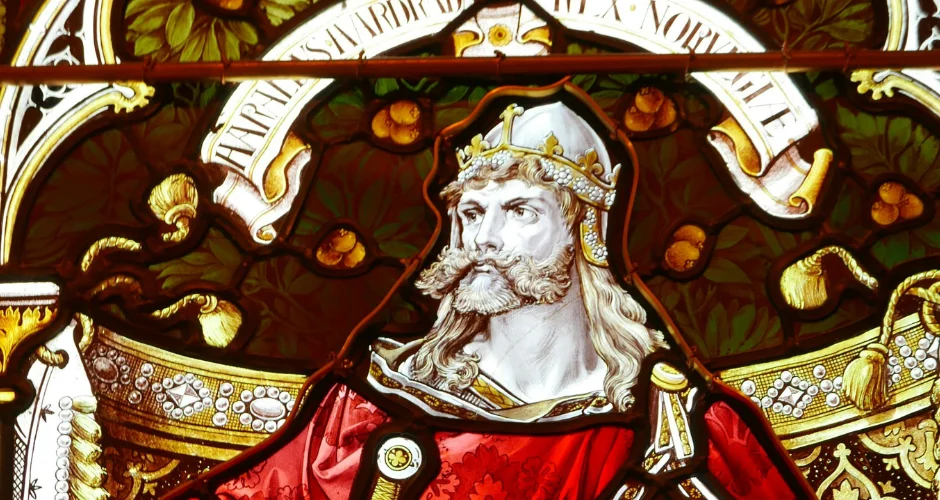
James I believed strongly in the Divine Right of Kings: the idea that monarchs were appointed by God and could not legitimately be overthrown by their subjects. According to this belief, harming a king was not just a political crime but a religious sin against God. The murder of a king, regicide, was therefore one of the most serious crimes imaginable.
When Macbeth murders King Duncan, the act is portrayed as a crime that disrupts the natural order of the world. Shakespeare emphasises this through strange and unnatural events: horses are said to eat one another and darkness covers the daytime sky. These events symbolise the idea that killing a king causes chaos in both society and nature.
| King | How He Rules | What He Represents |
|---|---|---|
| Duncan | Generous, trusting, divinely appointed — rules through justice and loyalty | The ideal of legitimate kingship — his murder disrupts the natural and divine order |
| Macbeth | Rules through fear, paranoia and violence — orders murder of Banquo and Macduff's family | The tyrant — represents the corrupting nature of power gained through immoral means |
| Malcolm | Returns order through legitimate succession and military victory | The restoration of rightful rule — but the circular structure leaves hope qualified |
"Shakespeare's portrayal of Duncan as a 'most sainted king' reinforces the importance of legitimate kingship in a society that believed monarchs were divinely appointed. By contrast, Macbeth's violent reign quickly descends into tyranny and fear, suggesting that power gained through regicide cannot be sustained – a message Shakespeare's 1606 audience, still shaken by political instability, would have found deeply resonant."
2. Gunpowder, Treason and Plot
The Gunpowder Plot of 1605, in which a group of conspirators attempted to assassinate James I by blowing up the Houses of Parliament, provides crucial context for Macbeth. Although the plot failed, it created widespread fear of treason and political conspiracy across England.
In this climate of anxiety, a play about a nobleman who murders his king would have felt powerful and immediately relevant. By setting the play in eleventh-century Scotland and presenting Banquo, whom James I believed to be his ancestor, in a positive light, Shakespeare was able to explore dangerous political themes while avoiding accusations of sedition.
The play repeatedly explores betrayal. It opens with the treachery of the Thane of Cawdor, establishing treachery as a central concern from the start. Macbeth himself begins as the model of loyalty, praised for his bravery and dedication to King Duncan before ambition begins to corrupt his sense of honour.
Exam tip: the reference to an 'equivocator' in Act 2 Scene 3 is widely understood as a direct reference to the Jesuit priest Henry Garnet, who was tried for his involvement in the Gunpowder Plot. This kind of topical reference would have been immediately understood by a 1606 audience.
"The Gunpowder Plot of 1605 created a climate of fear around treason and political conspiracy. Shakespeare exploits this by presenting Macbeth's treachery as not just a personal failing, but a violation of the divine and political order – ensuring his 1606 audience would have viewed Macbeth's actions with horror rather than sympathy."
3. The Supernatural: Witchcraft and Jacobean Belief
In the seventeenth century, many people believed that witches, ghosts and demons were real forces capable of influencing human life. James I himself had a strong personal interest in witchcraft. After surviving an assassination attempt and becoming increasingly concerned about supernatural threats, he wrote a book called Daemonologie in 1597, which discussed the dangers of witches and encouraged belief in their existence.

The witches are presented as mysterious and unsettling figures from the very beginning of the play. Their opening line 'Fair is foul, and foul is fair' suggests a world where normal moral boundaries are overturned and reality appears distorted. Shakespeare places the audience into an upside-down world from the first scene.
Although the witches never directly force Macbeth to commit murder, they introduce the idea of power and kingship into his mind. Their prophecy awakens a dangerous ambition that had previously remained dormant. This raises the central question that runs throughout the play:
Are the witches responsible for Macbeth's actions – or is he responsible for his own ambition? Shakespeare deliberately leaves this unresolved, creating the psychological complexity that makes the play a tragedy rather than a morality tale.
"The witches' prophecy does not command Macbeth to murder Duncan – it merely plants the idea. Shakespeare's deliberate ambiguity about whether the witches are agents of fate or projections of Macbeth's own desires reflects the Jacobean belief that supernatural forces could tempt but not compel, making Macbeth morally responsible for his own downfall."
4. Masculinity and Gender Expectations
In Shakespeare's society, men were expected to be strong, decisive and courageous, while women were generally expected to be obedient, passive and morally virtuous. These expectations formed part of the social order of the early seventeenth century.
Lady Macbeth challenges these expectations in striking ways. When she learns of the witches' prophecy, she immediately begins planning Duncan's murder. She calls upon supernatural forces to 'unsex' her, asking to be stripped of traditionally feminine qualities such as compassion and tenderness – mistakenly assuming that masculinity is defined by cruelty and the capacity for violence.
| Character | Gender Expectation | How Shakespeare Subverts or Reinforces It |
|---|---|---|
| Lady Macbeth | Women expected to be obedient, passive and morally virtuous | Rejects femininity entirely, calling on spirits to 'unsex' her — but is ultimately consumed by guilt, suggesting this rejection cannot be sustained |
| Macbeth | Men expected to be strong, decisive and courageous | Lady Macbeth weaponises this expectation, questioning his masculinity to push him into murder — Shakespeare critiques how toxic masculinity is used as manipulation |
| Macduff | Men expected to suppress emotion and respond to loss with action | Macduff weeps for his murdered family and says he must 'feel it as a man' — presenting a more humane, emotionally complete model of masculinity |
| Duncan | Kings expected to be strong leaders | Described as almost saintly and trusting — his 'feminine' qualities of generosity and trust are presented positively, not as weakness |
Shakespeare ultimately suggests that violating both moral and natural order leads to destruction. Lady Macbeth's power collapses into guilt and madness. Her sleepwalking scene is one of the most powerful demonstrations in the play that repressed guilt cannot be contained.
"Lady Macbeth's instruction to 'unsex' herself reflects the rigid gender expectations of the early seventeenth century, in which compassion was seen as a feminine weakness. However, Shakespeare ultimately shows that this rejection of femininity is unsustainable and she is consumed by guilt long before Macbeth, suggesting that moral violation, not gender, is what destroys her."
For more on how to build analytical paragraphs around character and theme, our post on using the PACCT method for analysing English Literature provides a reliable structure that works particularly well for questions on Lady Macbeth and gender.
5. Ambition and Moral Responsibility
At the heart of Macbeth lies the theme of ambition. Shakespeare does not present ambition itself as inherently evil. Macbeth is initially admired for his bravery and loyalty, and ambition can be understood as a natural human desire for success and advancement.
However, the play explores what happens when ambition becomes unchecked by morality.
After murdering King Duncan, Macbeth begins a cycle of violence that grows increasingly brutal. To protect the power he has seized, he orders the murder of Banquo and attempts to kill Banquo's son, Fleance. Later, he arranges the shocking slaughter of Macduff's wife and children. Each act of violence is driven by fear and paranoia, demonstrating how power gained through immoral means must constantly be defended through further cruelty.
"Shakespeare presents ambition as a 'vaulting' force that 'o'erleaps itself' – suggesting that unchecked ambition destroys the very thing it seeks to secure. Each murder Macbeth commits leads not to stability but to greater paranoia, demonstrating that power gained immorally cannot be maintained morally. These themes remain relevant today, as Shakespeare explores what happens when individual ambition overrides ethical responsibility."
If you find it difficult to connect themes like ambition to specific quotations in timed conditions, working with a GCSE English tutor can help you practise this skill systematically, building a bank of analytical responses you can adapt flexibly in the exam.
6. The Restoration of Order
By the end of Macbeth, Macbeth's tyranny has destabilised Scotland. Shakespeare restores order through Malcolm, Duncan's son, who ultimately becomes king. Malcolm represents the return of legitimate and divinely sanctioned rule. His victory suggests that justice will eventually prevail, even after periods of corruption and violence.
This resolution reinforces the political message of the play: rightful authority must be respected, and attempts to seize power through treachery will ultimately fail.
However, the circular nature of the ending complicates this resolution. Just as the play opens in a world already disturbed by betrayal and conflict, Shakespeare leaves the audience questioning whether order has truly been restored, or whether the conditions that created Macbeth's rise could one day emerge again.
"Malcolm's accession appears to restore the divine order disrupted by regicide, reinforcing Shakespeare's political message that legitimate kingship must be respected. However, the circular structure of the play – returning to the themes of betrayal and instability introduced in the opening scenes – suggests that the conditions for tyranny are never fully eliminated, leaving the audience with a deeply unsettled sense of order restored."

Why Context Matters for Your Essays
Understanding the historical and cultural background of Macbeth allows you to see the play as more than a story about murder and ambition. Shakespeare was writing for an audience deeply concerned with political stability, supernatural forces and the nature of authority. By exploring these ideas through dramatic characters and events, he created a tragedy that reflects both the anxieties of his own time and concerns that remain relevant today.
The most effective way to use context in your essays is not as a separate history paragraph, but woven directly into your analysis. One short, precise context point, linked tightly to a character, quotation or moment in the play, is worth far more than a general summary of Jacobean society.
For more on how to structure your essays for maximum marks, see our guides on how to write an analytical GCSE English essay, writing a great essay in six simple steps, and how to create an English Literature revision cheatsheet. And if you are also preparing for AQA English Literature Paper 2 poetry, our post on how to wow your GCSE poetry examiner in 5 steps covers AO3 in that context too.
Conclusion
Macbeth is a play shaped at every level by its historical moment. From James I's beliefs about kingship to Jacobean fears about witchcraft to early modern ideas about gender and morality, the context is not background to the play, it is the reason the play exists in the form it does.
Significantly, Shakespeare structures the play with a sense of circularity. Although order appears to be restored at the end with Malcolm's return to the throne, the audience cannot be entirely certain that stability will last. Just as the witches open the drama by declaring that 'fair is foul, and foul is fair', the play closes with the unsettling awareness that the moral order of the world can easily be overturned again.
The students who score highest on context are not the ones who know the most Jacobean history. They are the ones who connect it to the text most precisely and who can explain not just what Shakespeare wrote, but why.
If you would like support working through Macbeth with an experienced GCSE English tutor, Sherpa's tutors can help you develop your analytical writing with direct feedback on your context links and essay structure. Whether you are targeting a Grade 5 or pushing for a Grade 9, online tuition provides the focused, personalised practice that makes the biggest difference in timed exam conditions.
Parents
Students
Tutors

Sarah C
Tutor
GCSE specialist: structured exam technique, SEND experienced, measurable grade progress.



Looking for a tutor?
Sherpa has hundreds of qualified and experienced UK tutors who are ready to help you achieve your goals. Search through our tutors and arrange a free 20 minute introduction through our industry-leading online classroom.
Find a TutorSimilar Articles
