

GUEST POST
How to Master OCR A-Level Biology 6-Mark Questions

Tom is a qualified science teacher up to GCSE level with over 13 years of teaching experience including as Head of Science. He also specialises in A-Level Biology support.
Here, he gives his insight into how he helps students to maximise marks in OCR A-Level Biology's 6-mark questions in order to increase their chances of getting an A or A* grade.
A Biology Teacher’s Guide to Long Response Questions
By Tom H
Many students begin A-Level Biology expecting it to be just a harder version of GCSE. The amount of content certainly increases, however one of the biggest challenges is learning how to answer questions in the way examiners expect. The emphasis at GCSE is often on "what" you know, and although this is important at A-Level, this can only get you so far.
Each exam board has its own nuances about the types and style of question that they ask, and in OCR A A-Level Biology, the 6-mark question is a perfect example of where students often fall into traps (that sneakily, are often placed there deliberately by the examiners!). It's often the question that students dread most, not because they do not know the biological content, but because they're unsure how to structure their answer, or sometimes, what the question is actually asking.
In this article, I will break down the four main types of extended response question found in OCR A-Level Biology, however these skills are transferrable to other exam boards too. The article will also help to unpick the mark schemes and explain what examiners are looking for, as well as providing practical advice that students can apply immediately.
How the 6-Mark Questions Are Assessed
The 6-mark questions in OCR A-Level Biology are assessed by the examiner and awarded marks in a different way to regular questions. It is not as simple as making 2 points for 2 marks, 4 points for 4 marks and so on, but more about how the answer is structured as a whole and the level of biological content included in the response.
How the mark scheme looks will vary slightly between different question types, but the general rule of thumb to get 5 to 6 marks is as follows:
- Answer all parts of the question in detail.
- Include sufficient and correct scientific detail.
- Explain why and how, linking ideas together into a continuous chain of reasoning.
- Use a clear, logical structure that flows naturally.
- Use accurate biological terminology throughout.
- Make sure almost everything written is relevant, with few or no errors.
Type 1: Knowledge
The most straightforward type of extended answer question you can get is one that asks you to simply describe or explain a concept or process in biology (or as I like to call these questions, "tell me some stuff"). These might come in the form of a question such as:
- Describe the flow of blood through the left-hand side of the heart during the cardiac cycle and explain the roles of valves and pressure differences in this process.
- Explain how the structure of haemoglobin is related to its function in oxygen transport.
These questions, although clear in what they are asking, are often some of the more difficult questions to answer if you are not 100% confident with the content. They rely on you knowing a particular area of the syllabus in enough detail to produce an answer worth 6 marks.
Tips for achieving top marks:
- Read the question carefully. Have you taken note of the command word?
- Plan your answer so it is structured and in a logical order. Marks can often be awarded for ensuring that answers flow logically and processes are described in the order that they happen.
- Ensure key terminology in your answer is used effectively. Do not fall into the trap of using GCSE language in A-Level answers, such as simply saying "the water moves across the cell membrane" instead of correctly saying "the water moves across the plasma membrane."
Type 2: Design and Plan an Investigation
One of the hurdles that students often face when approaching practical work in A-Level Biology is that you may be asked in the exam to design and plan an investigation to test a particular hypothesis. This may sound simple, however it may be an investigation that you have not seen previously. Some examples of this type of question might be;
- Design an investigation to test the hypothesis that increasing temperature increases the rate of catalase activity up to an optimum temperature.
- A student believes that seedlings grown under blue light will grow faster than those under any other colour. Plan an investigation to test their idea.
These questions are not necessarily testing "what" you know, but rather your ability to think logically and apply practical skills that you have developed in the classroom, sometimes in an unfamiliar context.
Tips for achieving top marks:
Clearly state your variables. What will your independent, dependent and control variables be? They need to be practically achievable, for example, if you wanted to control the temperature that a plant grows in, carrying this out in a climate-controlled room is not always an option.
Logically sequence your method and plan, with enough detail that someone else could repeat your investigation without any ambiguity.
State how many times you will repeat your investigation and calculate a mean from your results. Would it be beneficial to carry out any additional statistical tests?
Explain exactly what data you will collect and how you will do this. For example, state you will collect the volume of gas every minute for 10 minutes using a gas syringe and that the units will be in mm3.
Consider whether you need a control experiment. This is different to a control variable, as this is an experiment used to determine whether the independent variable you changed is the one that actually had an impact.
For example, if you were investigating the effect of different concentrations of plant hormone on the rate of stem elongation, you would need a plant (or group of plants) that did not receive the hormone treatment in order to compare the results against.
Type 3: Improving an Investigation
This type of question can come in many forms. You will be given an investigation that has already been carried out, usually with some results, and asked how it can be improved. Examiners will always design these questions so that the information presented has flaws in it, as there wouldn't be anything to critique if you were given a perfect experiment.
They may deliberately fail to repeat the experiment, fail to control variables, or include errors in the data you are given.
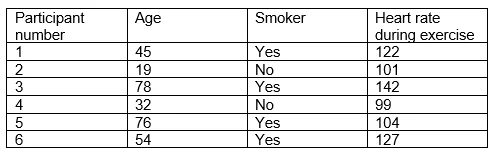
An example of experimental data included in an OCR A-Level Biology exam
Just from looking at this table of data, it is clear that there are multiple issues with both how the experiment has been designed and how the data is presented:
- There are no units for heart rate.
- The participants are different ages which may affect heart rate.
- There is no information about the sex of the participants.
- There are not equal numbers of smokers and non-smokers.
- There is no information about what type of exercise they have done.
- There is no information about how the heart rate has been measured.
- There is nothing to indicate that any repeats have been done.
- There is a very small sample size to make any valid conclusions from.
Tips for achieving top marks:
- Consider what information is not given, like the points outlined above. This is often a good place to start.
- Think about how you would plan the investigation yourself. Is there anything they have or haven't done that you would do differently in yours?
- Look at the presentation of the data, are there units in the column headings?
Type 4: Evaluate a Conclusion
The final type of question is quite different to anything you may have encountered in GCSE Science. This style of question will present you with an investigation, the data gathered, and a conclusion that has been drawn.
From the information given, you must evaluate the conclusion, providing evidence that supports it, evidence that goes against it, and reaching your own verdict as to which side presents the stronger argument.
Using the same data as in Type 3 above, the question may be something like:
"All smokers have a higher heart rate during exercise when compared to non-smokers."
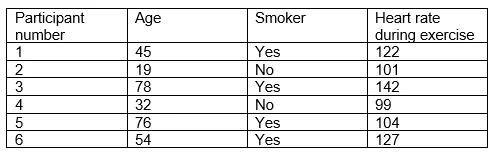
An example of experimental data included in an OCR A-Level Biology exam
Using the same data, evidence in support might be that the two non-smokers have lower heart rates, while evidence against includes the small sample size, uneven groups and lack of statistical testing.
The answers to these questions can be quite formulaic and will often include many of the same points outlined in Type 3 above. One point that is often credited on the mark scheme is that correlation does not necessarily equal causation.
Think about the fact that the two lowest heart rates are non-smokers as evidence in support, but they are also the two youngest participants in the investigation. It also does not tell us if any of the participants regularly exercise or not.
Tips for achieving top marks:
After outlining your points, it is good practice to come to a judgement of your own. This might sound something like: "I disagree with the conclusion made, as there is more evidence against the claim, and without information about control variables, a larger sample size, or more detail about the participants, a valid conclusion cannot be made."
An easy point to forget, is to consider what information is not given, and the impact that might have on the conclusion’s accuracy and credibility. Have they not told you about sample sizes, ages of participants, statistical tests etc.
Final Thoughts
Mastering these 6-mark questions in A-Level Biology is about far more than just memorising facts. Success comes from understanding what the question is asking, structuring your ideas clearly, and applying your knowledge in the ways that examiners expect.
Whilst every student will develop this at their own pace, working closely with an A-Level Biology tutor can help identify areas for improvement, build confidence, and perfect exam technique.
Students

Tom H
Tutor
Head of Science offering GCSE Science and A Level Biology Tuition



Looking for a tutor?
Sherpa has hundreds of qualified and experienced UK tutors who are ready to help you achieve your goals. Search through our tutors and arrange a free 20 minute introduction through our industry-leading online classroom.
Find a TutorSimilar Articles