
GUEST POST
Integration Without the Panic and How to Know Which Method to Use
Deepak is a Head of Maths with over 25 years' experience teaching A-Level Maths, including calculus and integration, using clear step-by-step methods. This article explains how to spot structural clues in integrals to choose between substitution, integration by parts and partial fractions.
Integration Without the Panic: How to Know Which Method to Use
By Deepak S | Head of Maths and A-Level Specialist | Sherpa Tutor
We’ve all been there. You look at an integration question and know how to integrate, but you have no idea which method you’re supposed to use. Substitution? Integration by parts? Partial fractions?
The good news is that selecting the right method doesn’t have to be guesswork. You can learn to spot patterns by looking for clues in the structure of the integral, which makes choosing the method much less daunting.
Think of integration techniques as tools in a toolbox. The trick is learning which tool matches which problem, a core skill in A-Level Further Maths as well.
Instead of starting with a definition or rigid set of rules for when to use each method, start with recognition.
Method 1: Substitution (When an Integral Is Hiding an Inner Function)
For example:
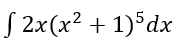
What stands out? The x² + 1. More importantly, its derivative, 2x, is sitting right outside it.
So, let
u = x² + 1
du = 2x dx
Through substitution, the complicated-looking integral becomes ∫u⁵ du.
The Takeaway
Look for a function whose derivative also appears, and replace it with u to make the integral simpler.
Method 2: Integration by Parts (When Two Functions Are Stuck Together)
For example:

Notice how this is a product of two terms, neither of which is particularly difficult to integrate or differentiate. Can we make it easier by differentiating one part and integrating the other?

But how do you decide which to integrate and which to differentiate?
Remember the LIATE acronym (a rule of thumb, not a law of mathematics) for choosing u.
Priority | Function |
L | Logarithmic |
I | Inverse Trigonometric |
A | Algebraic |
T | Trigonometric |
E | Exponential |
For the example above, LIATE suggests choosing:

Method 3: Partial Fractions (When a Fraction Needs Breaking Up)
Instead of learning that partial fractions are to be used for all rational functions, understand how partial fractions can pull fractions apart, leading to familiar logarithmic integrals.
For example:

They can now be integrated individually using logarithmic integration.
The Takeaway
So... Which integration method should you use?
When you see an unfamiliar integral, don’t immediately start manipulating it.
Ask yourself:
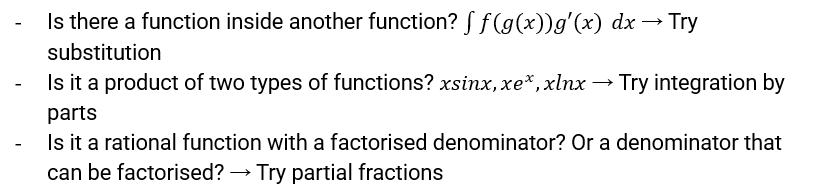
Integration can seem difficult because the hardest part isn’t always carrying out the method; it’s knowing where to begin. Next time you’re faced with a horrible-looking integral, don’t panic.
Don’t ask, “Which formula do I remember?”
Instead, ask, “What is making this integral difficult, and what clues can I spot?”
Once you’ve identified the problem, the method often becomes much clearer. With practice, recognising these patterns becomes easier, meaning that choosing the right integration method doesn’t have to be guesswork. Whether you're starting calculus in GCSE Further Maths or tackling tougher problems at A-Level, the recognition skills are the same.

Deepak S
Tutor
Head of Maths 25+ years experienced qualified teacher A level ,GCSE ,KS3 , teaching strategy ,Home ed , SEND ,ADHD etc


Looking for a tutor?
Sherpa has hundreds of qualified and experienced UK tutors who are ready to help you achieve your goals. Search through our tutors and arrange a free 20 minute introduction through our industry-leading online classroom.
Find a TutorSimilar Articles