

GUEST POST
What I Wish More People Knew Before Starting A-Level Economics

Daanish is a qualified teacher specialising in Maths, Economics, Business and Computing, with a multidisciplinary background spanning industry and education. He has developed and delivered bespoke online tuition across multiple exam boards, including OCR, AQA and Edexcel, at both A-Level and T-Level, and has experience teaching the Singaporean Maths method.
Here, he shares the two practical mistakes he sees most often in A-Level Economics, and the low-effort summer habits that make the subject click long before the first lesson.
How to Actually Prepare for A-Level Economics this Summer
By Daanish | A-Level Economics and Maths Tutor | Sherpa Tutor
Whenever I tell new students that the jump to A-Level Economics isn't about memorising a textbook, I usually get a sceptical look. But after tutoring dozens of kids through their exams, I can tell you exactly where the marks slip away and it’s rarely because they didn’t read the textbook enough. It’s the basics that catch people out.
If you're picking up Economics in September, or even if you're already a few months in and feeling the heat, here is the stuff I wish someone had told me before I started.
1. Don't fear the maths (but do fear the calculator)
Let’s get one thing straight: you do not need to be heading for an A* in Further Maths to ace Economics. But you absolutely cannot afford to be rusty on the basics of GCSE Maths.
I’m talking about calculating percentages, working out fractions, and understanding indices (like knowing that 2³ is 8). The maths itself is dead easy. The problem is the exam pressure.
I see so many students lose easy marks in data response questions because they stare at a table for five minutes trying to remember how to work out a percentage change on their calculator. By the time they've punched in the numbers and second-guessed themselves, the exam clock has ticked away and they've run out of time for the essay at the end.
The Tutor Hack
You need to build muscle memory. Practise doing basic percentage changes in your head or on scrap paper until it’s as natural as breathing. And please, watch out for the examiner’s favourite trick: the difference between a percentage increase and an increase to a percentage. If a price goes up from 10% to 15%, that’s not a 15% increase. It’s a 50% increase. Get that wrong, and you lose the mark.
2. Buy a ruler. Seriously.
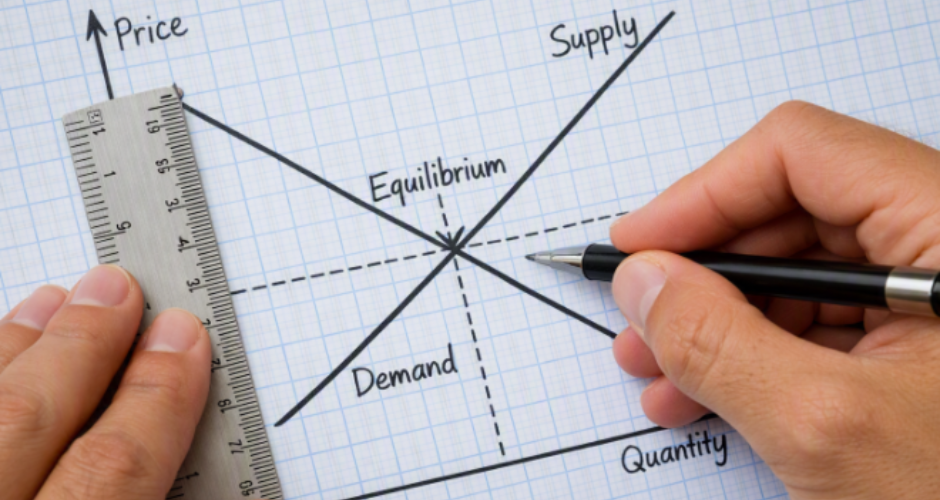
I know it sounds painfully obvious, but you’d be surprised. Roughly 20% of the marks in your A-Level papers will come from diagrams. You will draw supply and demand curves, cost curves, and production possibility frontiers until your hand physically hurts.
Here’s the thing about examiners: they are incredibly pedantic about graphs. If your lines look like they’ve been drawn during a bumpy bus ride, if you haven’t labelled your axes properly (it must say "Price" and "Quantity", not just "P" and "Q"!), or if you’ve used a thick marker pen instead of a sharp pencil, you will drop marks.
When a curve shifts, it needs to be a clean, smooth line. If it’s jagged, the examiner can’t tell if you meant to show a shift or just a wobbly hand. Get a decent ruler, a sharp pencil (and a pencil sharpener), and a good eraser.
It is literally the easiest 20% of the paper you will ever earn.
The "Low-Friction" Summer Wins:
If you want to walk into your first lesson feeling like you already have a handle on the subject, forget trying to read ahead in the textbook. Textbooks are dry. Instead, try absorbing how economists think rather than what they know.
Listen to Planet Money (NPR)
This is, hands down, the best podcast for A-Level students. I make all my tutees listen to it. The episodes are short (usually 20-30 minutes), incredibly engaging, and they explain complex economic ideas through storytelling.
They’ll do an episode on why milk is always at the back of the supermarket, or how a freeze in Florida affects the price of orange juice in London. That’s Economics in action. It trains your brain to look for the hidden incentives in everyday life without feeling like you’re studying.
Read something engaging, not academic
If you want a book to read by the pool, skip the textbook. Pick up Freakonomics by Steven Levitt and Stephen Dubner, or The Undercover Economist by Tim Harford.
They don’t teach you the A-Level syllabus, but they teach you the "lens" of an economist. They show you how to look at the world and ask, "What is actually motivating this behaviour?" Once you start seeing the world this way, the theory in the classroom clicks into place much faster.
Look at the news differently
This is where the top grades are won. When you see a headline about the government putting a tax on plastic packaging, or a sudden shortage of tomatoes in the supermarkets, don't just read it and move on. Play detective.
Ask yourself: Who benefits from this? Who loses out?
If plastic is more expensive, how will firms change their packaging? Will they pass the cost on to shoppers? If you start doing this now, forming evaluations and chains of reasoning will feel totally natural when you have to write your first 15-mark essay. You won't have to fake critical thinking - it’ll already be a habit.
The Bottom Line
The jump to A-Levels is notoriously tough, but Economics is one of those weird subjects where the difficulty doesn't come from the sheer volume of stuff you have to memorise. It comes from the shift in how you have to think.
You have to get comfortable with the idea that there are rarely absolute "right" answers in Economics. There are only well-reasoned arguments backed by models. It feels a bit vague at first, and that's okay.
Sharpen your pencil, download a podcast, and give yourself permission to be a bit confused for the first few weeks. It’s completely normal. Once the penny drops about how to think like an economist, it actually becomes one of the most interesting subjects you can take.
Parents
Students

Daanish
Tutor
Experienced tutor specialising in personalised learning for success.



Looking for a tutor?
Sherpa has hundreds of qualified and experienced UK tutors who are ready to help you achieve your goals. Search through our tutors and arrange a free 20 minute introduction through our industry-leading online classroom.
Find a TutorSimilar Articles