

GUEST POST
Why Times Tables Still Matter at GCSE
Rebecca is a qualified Maths and Numeracy Teacher with a PhD in Mathematical Modelling and Physics and 20 years of tutoring experience across the full school age and ability range. Having taught maths undergraduates, A-Level students, primary and secondary pupils abroad, and post-16 students retaking GCSE Maths, she brings a rare breadth of mathematical expertise to one-to-one tutoring.
Here, she makes the case for why times tables remain one of the most important foundations in mathematics and shares the strategies that actually make them stick.
Do Times Tables Still Matter?
By Rebecca | GCSE Maths Tutor and PhD Mathematician | Sherpa Tutor
Times tables are often thought of as primary school maths. However, strong times tables knowledge makes a huge difference at KS3, GCSE and A-Level Maths.
How can a student calculate percentages without times tables? Solve a ratio problem? Expand an algebraic bracket?
Students who can quickly recall multiplication facts have more mental space available for the harder parts of the problem.
They can factorise quadratics, find common denominators for fraction addition and subtraction, and calculate area and volume.
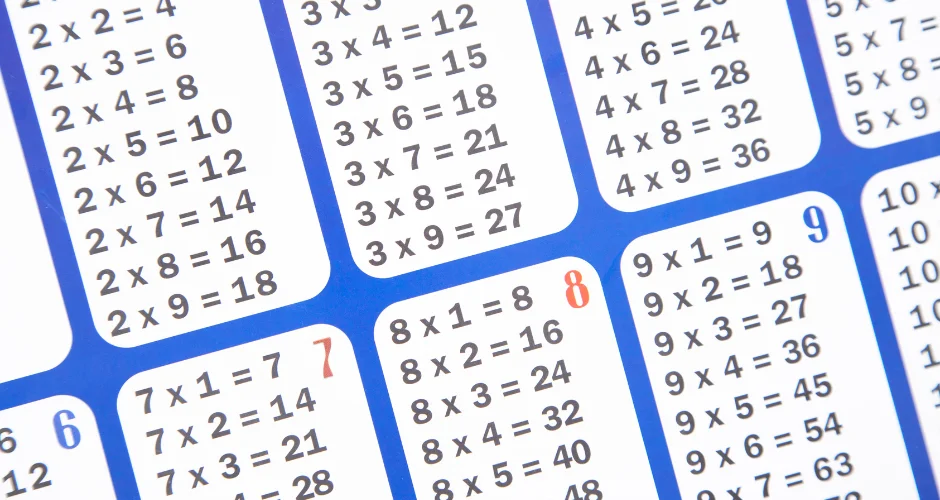
In exams, swift multiplication recall saves valuable time. Knowing 7 x 8 = 56 is quicker than running through the 7 or 8 times table in your head. Knowing that 10 and 15 are multiples of 5, or that 12 and 36 are multiples of 6, makes simplifying fractions and ratios speedy.
Recognising multiplication facts helps identify correct methods for solving problems. When factorising quadratics, recognising when to take out common factors or use the difference of two squares relies on recognising that 3 is a factor of 12 and 18, that 5 x 5 = 25, or that 8 x 8 = 64.
Strong times table knowledge is the key to confidence. If a student struggles with multiplication, that gap affects their entire maths journey. A starter question becomes a hurdle, a stepping stone question drags them down, and harder problems are simply inaccessible. You can see the effect that can have on confidence if left unchecked.
How Can You Master Your Times Tables?
It’s never too late to strengthen times table knowledge.
A few minutes of regular practice can make a huge difference. The aim is to recognise the relationship between the times tables, not just to memorise lots of facts.
Consistent practice will improve accuracy and speed and give students strategies to use when they don’t immediately remember a particular fact.
Learn in bite-size chunks
Focus on one or two tables at a time.
Keep coming back to it until it sticks.
Start with the 2, 5, and 10 times tables.
Then move on to the 3, 4, 9, and 11 times tables.
And finally, the 6, 7, 8, and 12 times tables.
Spot patterns
x 2 are all even.
x 5 end in 0 or 5.
x 10 end in 0.
x 9 digits add up to 9.
x 11 have repeated digits.
Apply what you already know
3 x 12 is the same as 12 x 3.
If you know 10 x 6 = 60, you can work out 11 x 6 by adding 6 to 60, and 9 x 6 by subtracting 6 from 60.
If you know 3 x 2 = 6, then double it to find 3 x 4, and double it again to find 3 x 8.
If you know 2 x 4 = 8, then multiply it by 10 to find 2 x 40 or 20 x 4.
Recognise the most useful ‘other’ tables
Multiples of 25, 50 and 100 are extremely useful for understanding the building blocks of larger numbers.
2 x 25 = 50
4 x 25 = 100
2 x 50 = 100
5 x 100 = 500
Regular short five-minute practice sessions will soon increase knowledge, increase confidence, and have a domino effect on all areas of GCSE Maths.
Parents
Students

Rebecca M
Tutor
Experienced, supportive maths tutor helping students build confidence, strengthen skills and achieve improved grades.



Looking for a tutor?
Sherpa has hundreds of qualified and experienced UK tutors who are ready to help you achieve your goals. Search through our tutors and arrange a free 20 minute introduction through our industry-leading online classroom.
Find a TutorSimilar Articles