
GUEST POST
WJEC Criminology Unit 2: Getting the Theory Right

Rob is a WJEC Criminology Unit 2 Examiner and experienced Teacher who helps learners apply criminological theories with clear, exam-focused guidance. This article explains practical ways to organise and recall Unit 2 theories, distinguish between them, and use mnemonics to choose and apply the right theory in exams. If you're studying A-Level Criminology, the strategies below will help you prepare with confidence.
WJEC Criminology Unit 2: Getting the Theory Right
By Rob P | WJEC Criminology Examiner and Teacher | Sherpa Tutor
WJEC Criminology Unit 2: Getting the Theory Right
One of the challenges students face with WJEC Level 3 Criminology Unit 2 is the sheer number of theories they need to understand, remember and, most importantly, apply.
We have biological, individualistic and sociological explanations of criminality. Within those categories are further subdivisions, and then there are the individual theorists, studies and explanations themselves.
It's a lot to remember!
What I often emphasise to my students is that knowing the name of a theory is only the starting point. Being able to select the correct theory for a question, explain it accurately and apply it to a particular crime or behaviour is what really matters.
Students can sometimes understand a theory perfectly well when we discuss it in class, but then struggle to recall it under examination conditions. Others remember the name but confuse the explanation with another theory.
For example, understanding the difference between learning theories, psychodynamic explanations and cognitive theories is essential — concepts you'll also meet in A-Level Psychology. They all fall under the wider individualistic approach but explain criminal behaviour in very different ways.
The same applies when distinguishing between genetic and physiological explanations, or between social structure theories, interactionism and realism — core perspectives in A-Level Sociology.
Getting those distinctions right can make a real difference to the quality of an examination answer.
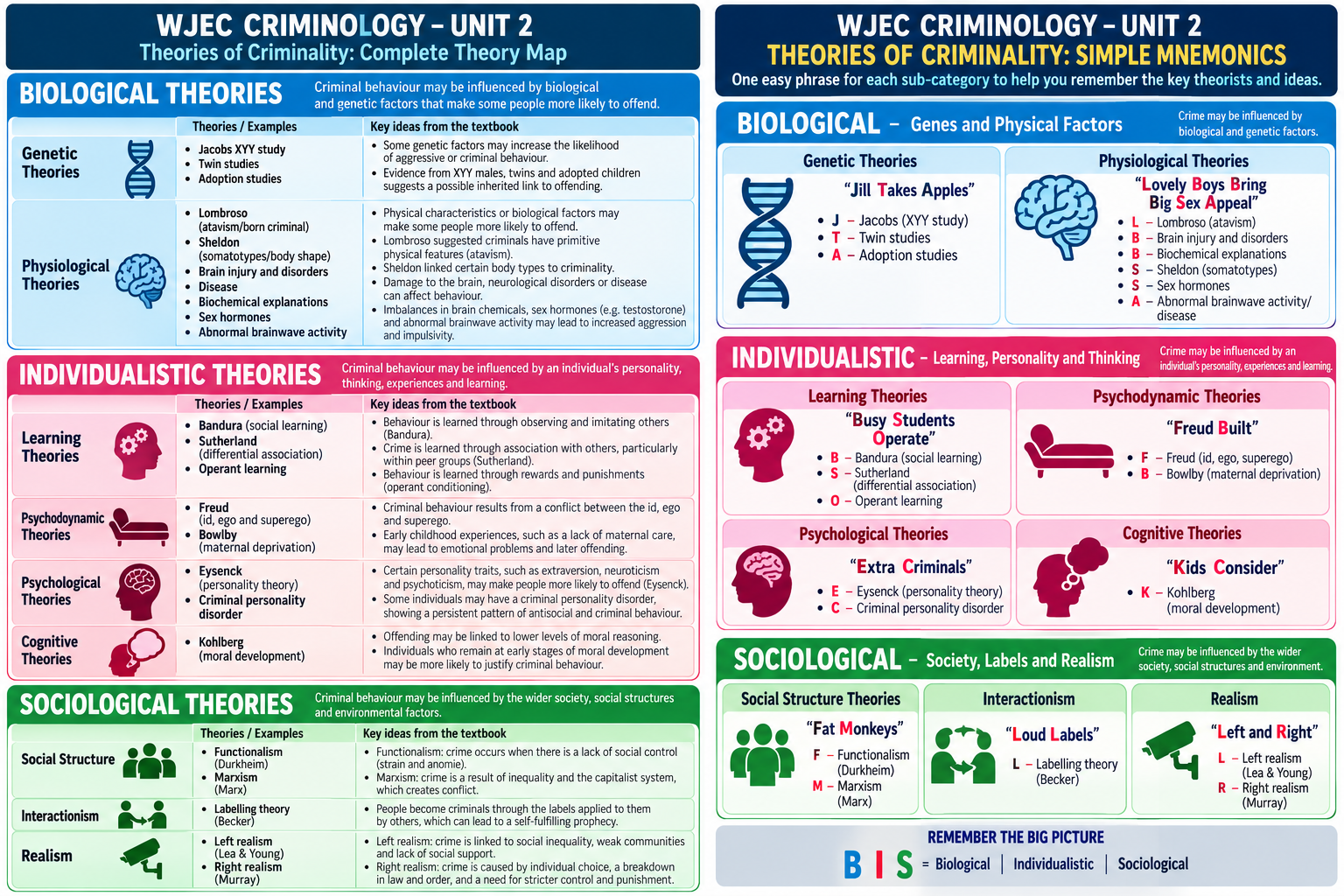
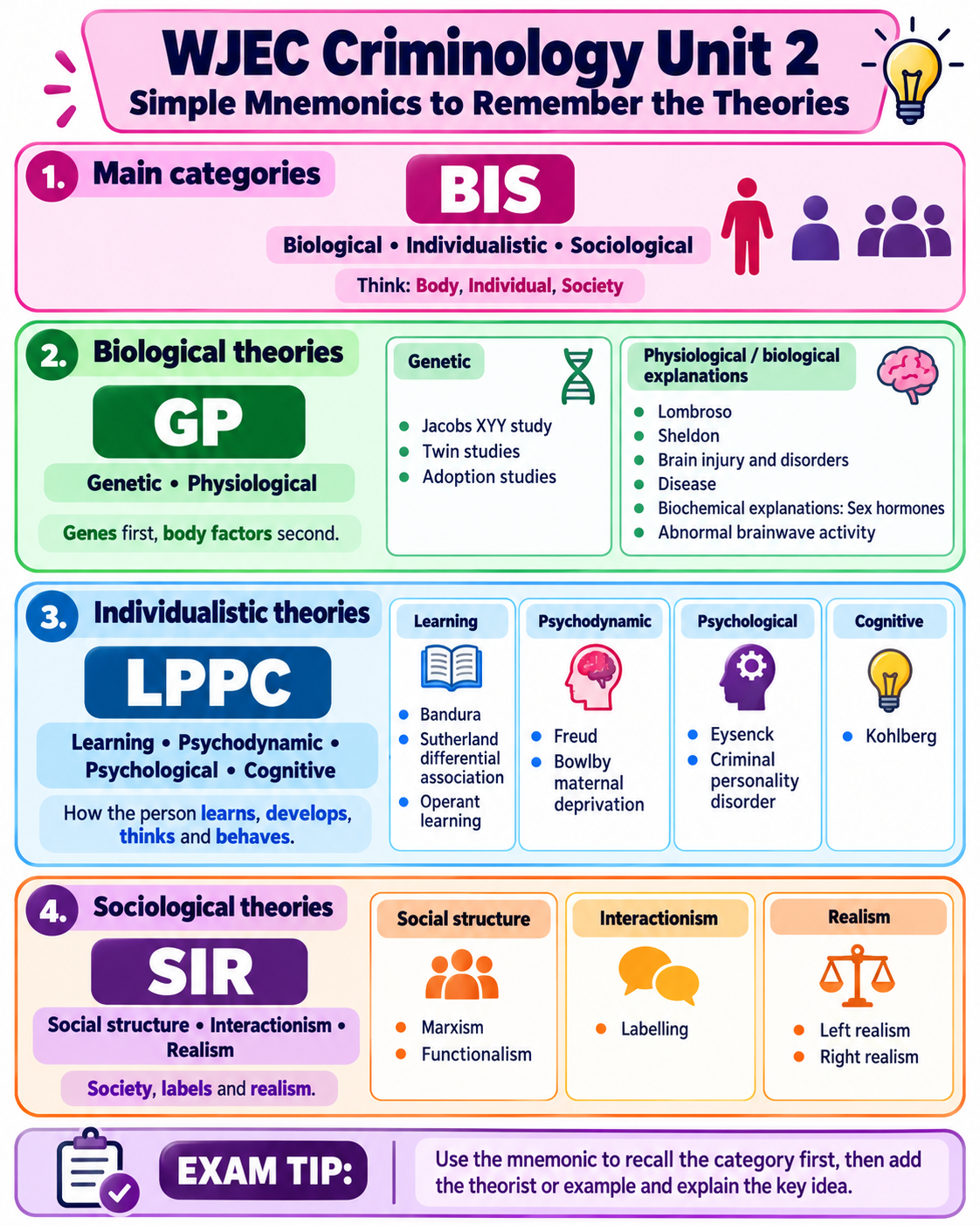
I've put together two infographics to help my students organise and recall the theories covered in Unit 2, including additional explanations explored in their textbook.
The first provides a visual overview of the categories, subcategories and individual theories. The second introduces mnemonics to help students remember them.
Now, I'll be the first to admit that some of my mnemonics are absolutely terrible! 😂
But that's partly the point.
They provide a framework (somewhere for students to start) when faced with a considerable amount of information.
In fact, I actively encourage my students to create their own mnemonics. The more ridiculous, personal or memorable they are, the better. What works for one student might mean absolutely nothing to another.
More importantly, the process of creating their own memory aids encourages students to engage with the material, organise their knowledge and think about how the different theories fit together.
Of course, a mnemonic alone won't secure marks. Students still need to understand the explanation, use appropriate terminology, apply their knowledge and evaluate the strengths and weaknesses of theories where required.
However, if a simple memory aid helps a student recall the correct theory in an examination, it's done its job.
Sometimes the simplest strategies can make a real difference.
And if my students come up with better mnemonics than mine, which, frankly, shouldn't be difficult, I'll happily steal them for next year's lessons! 😂
Just so you know, I stole "lovely boys bring big sex appeal" from a student. 🤣
Parents
Students

Rob P
Tutor
WJEC Criminology Units 1 & 2. Experienced Teacher, Moderator and Examiner.


Looking for a tutor?
Sherpa has hundreds of qualified and experienced UK tutors who are ready to help you achieve your goals. Search through our tutors and arrange a free 20 minute introduction through our industry-leading online classroom.
Find a TutorSimilar Articles