

GUEST POST
Ratios and Fractions. A Bar Model Guide for Key Stage 3 and GCSE Maths
Menard is a qualified Maths Teacher helping KS3 and GCSE pupils build confidence, using clear explanations and visual models to strengthen understanding of ratios and fractions. If you're looking for extra support, explore GCSE Maths tutors. This article shows how to use counters and bar models to connect ratios with fractions, share amounts in a given ratio, and work backwards when one part is known.
Ratios and Fractions: A Bar Model Guide for Key Stage 3 and GCSE Maths
By Menard D | Qualified KS3 and GCSE Maths Teacher | Sherpa Tutor
Ratio and Fractions
A Bar Model Guide for KS3 and GCSE Maths
A bag contains only red and blue counters in the ratio 2:3.
What fraction of the counters is red?
If you are tempted to say two-thirds, pause and consider what the 3 represents. It describes the blue part, not the whole collection. Understanding that distinction helps with several types of ratio questions.
Whether you're revising for an exam, teaching the topic, or supporting a child's learning at home, counters and bar models can help you:
· Connect ratios with fractions,
· Share an amount in a ratio, and
· Work backwards when one part is known.
Comparing One Part with the Whole
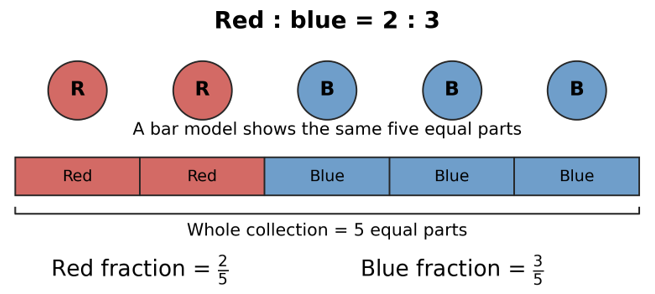
The ratio red:blue = 2:3 means there are 2 red counters for every 3 blue counters.
Start with the smallest whole-number collection: 2 red and 3 blue.
That makes 5 counters altogether.
2 of those 5 counters are red, so two-fifths or 2/5 of the total are red.
3 of those 5 counters are blue, so the remaining three-fifths or 3/5 of the total are blue.
The two fractions add up to one whole.
Two-thirds, or 2/3, still has meaning here: the number of red counters is two-thirds, or 2/3, of the number of blue counters.
The comparison changes when the question asks about all the counters.
Always identify what the fraction is a fraction of.
The ratio does not mean there must be exactly five counters.
Four red and six blue counters also fit the ratio 2:3.
Red counters then make up four-tenths of the total, which simplifies to two-fifths or 2/5.
Turning the Ratio into Equal Parts
In the bar model, every small box represents an equal amount.
Two boxes belong to red and three to blue, making five equal parts in total.
A box could represent one counter, four counters, or an amount of money. Its value depends on the information in the question.
Sharing an Amount in a Ratio
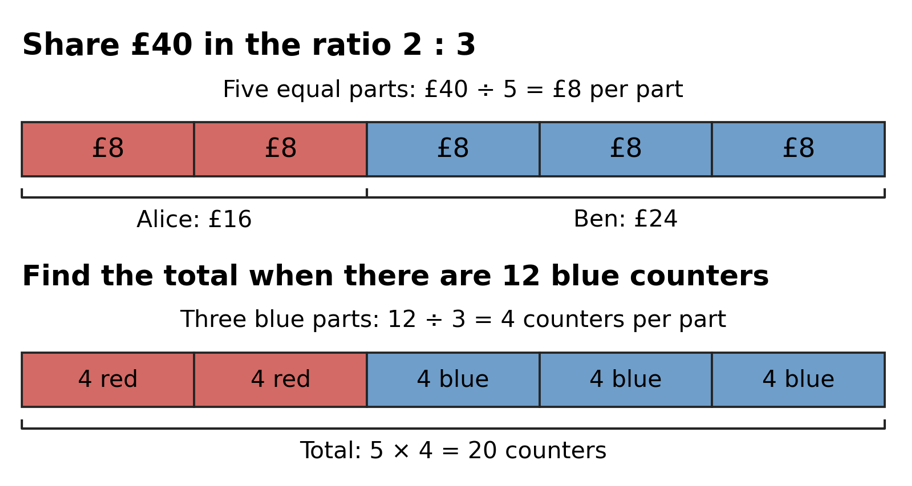
Alice and Ben share £40 in the ratio 2:3.
The order matters: Alice receives two parts and Ben receives three.
The £40 is the whole amount, represented by all five boxes.
· Find the total number of equal parts: 2 + 3 = 5
· Find the value of one part: £40 ÷ 5 = £8
· Alice receives two parts: 2 × £8 = £16
· Ben receives three parts: 3 × £8 = £24
This uses fractions:
· Alice receives two-fifths or 2/5 of £40.
· Ben receives three-fifths or 3/5 of £40.
Check that £16 + £24 = £40, then simplify 16:24 to confirm that the ratio is 2:3.
These checks test both the total and the way it has been shared.
Finding the Total from One Known Part
Now return to the counters.
Red and blue are still in the ratio 2:3, but this time there are 12 blue counters.
How many counters are there altogether?
Those 12 counters belong to the three blue parts.
Each part therefore contains 12 ÷ 3 = 4 counters.
The whole collection has five parts, so the total is 5 × 4 = 20 counters.
The two red parts contain 2 × 4 = 8 counters.
Check that 8 + 12 = 20 and that 8:12 simplifies to 2:3.
The first step depends on what is known: £40 represented all five parts, while 12 blue counters represented only three.
Label that information on the diagram before calculating.
Common Mistakes to Watch For:
Using the second ratio number as the denominator.
For red:blue = 2:3, the whole contains five parts.
The fraction that is red is two-fifths or 2/5.
Dividing by the wrong number of parts.
Match the known amount to its boxes first.
A total of £40 covers five parts; 12 blue counters cover three.
Adding the same number to both ratio terms.
Equivalent ratios are made by multiplying or dividing both terms by the same non-zero number.
Doubling 2:3 gives 4:6.
Adding 2 to each term gives 4:5, which is a different ratio.
Try These Questions:
1. Red and blue counters are in the ratio 3:4. What fraction of all the counters is red?
2. Maya and Leo share £56 in the ratio 3:4. How much does each receive?
3. Red and blue counters are in the ratio 3:4. There are 20 blue counters. Find the total number of counters.
4. Two-fifths or 2/5 of a collection of counters are red and the rest are blue. Write the ratio red:blue.
Sketch equal boxes and label what you know. Before calculating, decide whether the information refers to one colour, one person, or the whole amount.
Answers and Checks:
1. Three-sevenths or 3/7. There are 3 + 4 = 7 equal parts, and three are red.
2. Maya receives £24 and Leo £32. One part is £56 ÷ 7 = £8. The amounts total £56, and 24:32 simplifies to 3:4.
3. There are 35 counters altogether. Four blue parts contain 20 counters, so each part contains five. All seven parts contain 7 × 5 = 35 counters, including 15 red.
4. The ratio is 2:3. Two of the five equal parts are red, leaving three blue parts.
Making the Reasoning Clear
If you are supporting a pupil at home, ask them to explain what one box represents and which boxes make up the whole. Give them time to point, draw, or talk through their thinking before suggesting a calculation.
On your next ratio question, start by labelling the parts and identifying the whole. When an amount is given, match it to the right parts before calculating. This gives each step a clear purpose and helps you check whether your answer makes sense.
Parents
Students

Krishan S
Tutor
Oxford medic and future doctor with over 4 years experience tutoring.



Looking for a tutor?
Sherpa has hundreds of qualified and experienced UK tutors who are ready to help you achieve your goals. Search through our tutors and arrange a free 20 minute introduction through our industry-leading online classroom.
Find a TutorSimilar Articles