

GUEST POST
GCSE Physics Space Topic: The Complete Revision Guide (AQA, Edexcel and OCR)
What Is Covered in the GCSE Physics Space Topic?
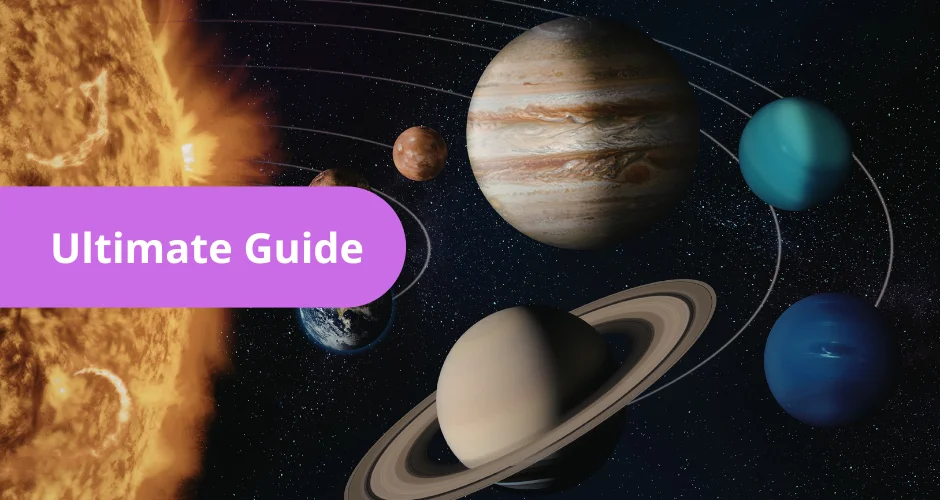
The GCSE Physics Space topic covers: the life cycle of stars, the structure of the Solar System, orbital motion and gravitational forces, the origin of the Universe through the Big Bang, and the evidence for an expanding Universe through red-shift and Hubble’s observations. It appears on Paper 1 for AQA, Edexcel and OCR.
Introduction: The Night Sky
People have looked at the night sky in wonder for a very long time. The oldest found astronomical depictions are 30,000 to 40,000 years old, in the form of cave paintings. In Germany a 32,500 year old mammoth tusk was found with what looks like carvings representing the Orion constellation. We also know that the Babylonians kept detailed records of planets, moon and stars and used them for navigation and agricultural timekeeping.
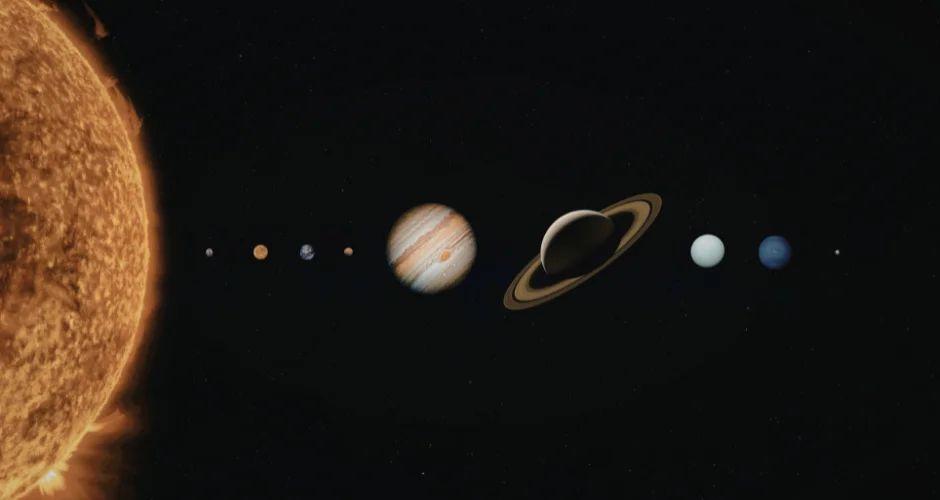
Our home planet Earth is the third of eight planets orbiting the Sun. The solar system however consists of a lot more than just eight planets. Most of the planets have orbiting moons like our own moon. The four outer planets (gas giants) have rings around them. Saturn’s rings are bright and were discovered early in our study of the planets. Jupiter, Uranus and Neptune have darker and fainter rings. The asteroid belt lies between the orbits of Mars and Jupiter consisting of millions of rocky and metallic bodies - a remnant of the solar system’s formation 4.6 billion years ago.
Asteroid sizes range from tiny, about 10 m across, to the dwarf planet Ceres which is the largest body in the belt with a diameter of about 950 km. Other dwarf planets such as Pluto reside at the outer edge of the solar system in the Kuiper Belt. Comets normally follow highly elliptical orbits but are also part of the solar system.
Our solar system is one of billions of star systems in our home galaxy, the Milky Way. If you're deciding whether to study Physics as a separate science, our guide on choosing between Combined or Triple Science covers what each route involves and the differences in content.
Formation of the Sun and Solar System
The solar system with the Sun at the centre formed 4.6 billion years ago from a huge cloud of dust and gas pulled together by gravity. A cloud of dust and gas is called a nebula.
A shock wave from a nearby exploding supernova (a dying large star), a collision with another nebula or a passing star, can trigger a large cloud of dust and gas to start contracting under its own force of gravity.
As the nebula collapses, the gravitational force increases as can be deduced from Newton’s law of universal gravitation given by the equation:
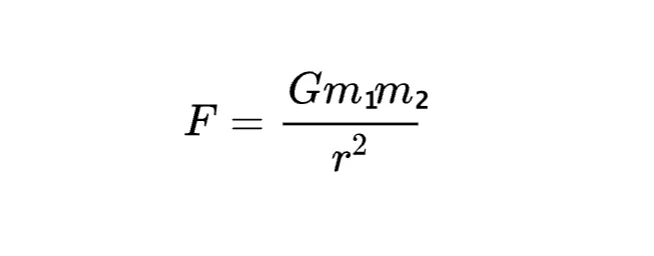
Newton's Law of Universal Gravitation — F = Gm₁m₂ / r² — where F is gravitational force (N), G is the Gravitational Universal Constant (m³kg⁻¹s⁻²), m₁ and m₂ are the masses of two objects (kg), and r is the distance between their centres (m)
As gravity pulls the gas and dust together, the increasing density and particle collisions cause the temperature and pressure to rise forming a protostar. It typically glows in infrared light due to heat generated by gravitational contraction.
A point is reached when the temperature and pressure at the core of the protostar are high enough that hydrogen nuclei can overcome the repulsive force between them and start to undergo nuclear fusion to form helium nuclei. This nuclear reaction gives out huge amounts of energy which keeps the core hot and under pressure. The initiation of nuclear fusion marks the birth of a new star.
During the process of formation the new star sucks in most of the material in the original nebula as its gravity completely dominates its surroundings. In our solar system the Sun accounts for 99.86% of the total mass of the solar system leaving just 0.14% for everything else! At this scale the Earth’s mass is basically negligible!
For more on how maths underpins Physics like this, see our post on how maths and physics are intertwined in our daily lives.
The Life Cycle of a Star
After the new star is born it enters a very long stable period where the outward pressure generated by the intense energy from nuclear fusion is balanced by the force of gravity still trying to compress the star. This is known as the main sequence period and lasts for several billion years. Our Sun is in the middle of its main sequence period at approximately 4.6 billion years old.
Notwithstanding its immense mass, the Sun’s core hydrogen fuel is finite, and depletion is inevitable. When core hydrogen starts to run out, the fusion reaction will start to decline causing a decrease in the energy output which in turn causes the pressure in the core to drop. Gravity takes the upper hand again and the core will start to contract. As the core contracts it heats up and pressure increases again.
When the temperature and pressure are high enough helium nuclei start fusing together to form heavier elements such as carbon, nitrogen and oxygen. Helium fusion releases huge amounts of energy causing the star to expand into a red giant. This is a relatively violent time in the life of the star. When even helium fuel runs out our Sun will become unstable and eject its outer layer of dust and gas leaving a hot, dense solid core known as a white dwarf.
No more energy from fusion can be achieved by a small to medium sized star such as our Sun. As time (trillions of years) passes by, the white dwarf cools down and finally becomes a cool dark body known as a black dwarf.
Lower-mass stars such as our Sun stop at helium burning. Massive stars however continue to fuse heavier elements in their cores. As each new fuel burns, the star pulsates between expanding into a red supergiant and contracting. Different elements form around the core in layers like an ‘onion’. Eventually the star explodes in a supernova, leaving behind either a neutron star or a black hole.
The table below summarises the two life cycle paths:
| Stage | Sun-Sized Stars | Massive Stars |
|---|---|---|
| Nebula | Cloud of dust and gas contracts under gravity | Cloud of dust and gas contracts under gravity |
| Protostar | Gravitational contraction heats the core; glows in infrared | Gravitational contraction heats the core; glows in infrared |
| Main Sequence | Hydrogen fusion begins; stable for billions of years | Hydrogen fusion begins; stable but shorter-lived |
| Red Giant / Supergiant | Core contracts; helium fusion begins; star expands | Expands into a red supergiant; fuses heavier elements in layers |
| End Stage | Ejects outer layers; leaves a white dwarf | Explodes as a supernova; leaves a neutron star or black hole |
| Final State | White dwarf cools over trillions of years into a black dwarf | Neutron star or black hole |
Our Solar System
Our Solar System consists of 8 planets (Mercury, Venus, Earth, Mars, Jupiter, Saturn, Uranus and Neptune – in order from the Sun).
Most planets have a number of moons orbiting them. Our Moon is very large relative to planet Earth with a diameter of just over a quarter of the Earth’s. Mars has 2 small moons, but the gas giant planets have numerous moons – currently Jupiter has 101 officially recognized moons. Mercury and Venus have no known moons.
Other bodies such as Pluto in the Kuiper belt and Ceres in the main asteroid belt are known as dwarf planets. The Solar System is also home to minor planets and comets.
| Planet | Type | Position from Sun | Moons | Notable Feature |
|---|---|---|---|---|
| Mercury | Rocky | 1st | 0 | No atmosphere; extreme temperature swings |
| Venus | Rocky | 2nd | 0 | Hottest planet despite not being closest to the Sun |
| Earth | Rocky | 3rd | 1 | Only planet known to support life |
| Mars | Rocky | 4th | 2 | Home to Olympus Mons, the largest volcano in the solar system |
| Jupiter | Gas giant | 5th | 101+ | Great Red Spot — a storm larger than Earth |
| Saturn | Gas giant | 6th | 80+ | Bright, visible rings of ice and rock |
| Uranus | Ice giant | 7th | 27 | Rotates on its side; faint rings |
| Neptune | Ice giant | 8th | 16 | Strongest winds in the solar system |
Because of the everlasting pull of gravity nothing in space can be stationary! Everything including planets is on the move normally moving in an orbit. Moons orbit planets as planets orbit the Sun. The Sun together with the entire solar system orbits the center of the Milky Way galaxy in approximately 225 to 250 million Earth years.
Planetary orbits are elliptical in accordance with Kepler’s first law of planetary motion. The Sun sits at one of the ellipse’s two foci. The closer a planet is to the Sun, the stronger the gravitational force and the faster the orbiting planet needs to travel to remain in orbit.
The orbital speed of a planet can be calculated using the following equation:
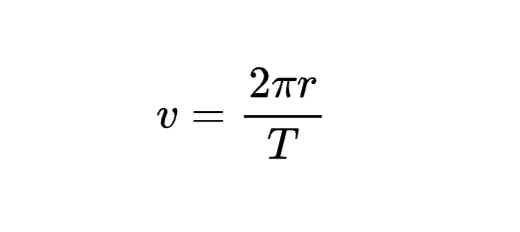
Orbital Speed Equation — v = 2πr / T — where v is orbital speed (m/s), r is the average orbital radius (m), and T is the orbital period (s)
For a full list of the Physics equations you need for your exam, see our GCSE Physics equations sheet.
The Origin and Expansion of the Universe
In 1929 Edwin Hubble published his observation that the Universe is expanding. Actually the farther away a galaxy is the faster it is moving away from us. This observation is valid in every direction in the Universe. T
he evidence for this expansion comes from the fact that the further away a galaxy is, the redder it appears to be. Basically light coming from distant galaxies is red-shifted, its wavelength being stretched to a longer wavelength as it travels towards us.
This happens because the fabric of space itself is expanding, stretching the light waves traveling through it. So rather than moving away from each other through space, galaxies are being carried further apart as the fabric of space itself grows!
Red-Shift Explained
Different elements in the Sun absorb some of the emitted wavelength as shown in figure 1. These absorbed wavelengths show as dark lines on the emission spectrum. By analysing the specific wavelengths of light absorbed by atoms, we can identify the elemental composition responsible for the dark absorption lines in a spectrum.

Figure 1: Part of the Sun's emission spectrum showing absorption lines
When we observe light from a distant galaxy, the same absorption lines are present - but they have been shifted towards the red end of the spectrum. This red-shift tells us the same elements are present, but the light has been stretched by the expansion of space as it travelled towards us. The further away a galaxy is, the larger the red-shift and the faster it is receding.

Figure 2: The spectrum from a different galaxy
Careful analysis of figure 2 shows that the spectrum of light from a distant galaxy has absorption lines which do not match those from our Sun. The same lines are present on the distant galaxy’s spectrum but they have been shifted to the right – the red end of the spectrum. We say that light has been red-shifted. From this observation we conclude that the same elements are present in the distant galaxy but the absorption lines have been shifted to the red end of the spectrum due to the expansion of space itself.
The Big Bang
The expansion of the Universe implies that in the past it was much smaller. If we go back in time far enough the whole Universe must have been very small, just a single extremely dense and hot point. The Big Bang theory tells us that 13.8 billion years ago this extremely hot and dense point (known as a singularity) started to expand rapidly and time started to flow.
The Big Bang was not an ‘explosion’ in space but rather the initiation of this rapid expansion of space itself together with the flow of time. Space and time are linked (referred to as spacetime), so that the expansion of space was also the initiation of time. It occurred everywhere at once, rather than expanding from a center!
For more on the evidence for the Big Bang and how it is examined at GCSE, see our post on whether the Big Bang provides enough evidence for the origins of the Universe. For something more speculative, our post on interstellar travel: science fiction or reality explores what current physics tells us about travelling beyond our solar system.
Worked Example: Edexcel GCSE Physics Paper 1, Higher Tier, May 2024
Question 1(a): Multiple Choice
Nuclear fusion is a process that releases energy.
Which of these statements applies to a nuclear fusion reaction?
| Option | Statement | Why It Is Right or Wrong |
|---|---|---|
| A | It emits daughter nuclei | Incorrect. Nuclear fusion does not emit daughter nuclei. |
| B | It is a controlled chain reaction | Incorrect. Fusion is not a chain reaction and does not require external neutrons like fission does. |
| C | It produces radioactive waste | Incorrect. Fusion does not produce radioactive waste. |
| D ✓ | It requires high temperature and pressure | Correct. Fusion requires extremely high temperature and pressure to force nuclei together. |
Question 1(b): Percentage Mass Calculation
In the Sun, four protons start the process of nuclear fusion.
These protons combine and finally produce a helium nucleus.
The helium nucleus has a smaller mass than the four protons.
This difference in mass is converted to energy.
Four protons have a total mass of 6.69 × 10⁻²⁷ kg.
A helium nucleus has a mass of 6.64 × 10⁻²⁷ kg.
Calculate the percentage of the original mass that has been converted to energy.
Step 1: Find the mass converted to energy.
6.69 × 10⁻²⁷ − 6.64 × 10⁻²⁷ = 5.0 × 10⁻²⁹ kg
Step 2: Calculate the percentage.
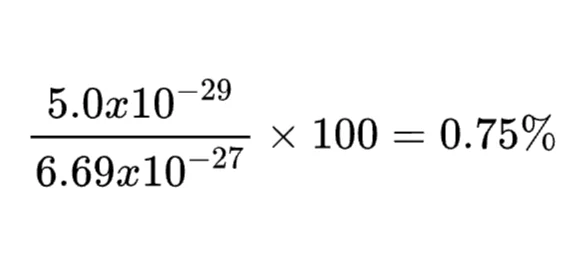
Percentage mass calculation — (5.0 × 10⁻²⁹ / 6.69 × 10⁻²⁷) × 100 = 0.75%
Question 1(c): Red-Shift
Figure 1 shows the spectrum of an element detected in the light from a distant galaxy, from a nearby galaxy and from a source on Earth.
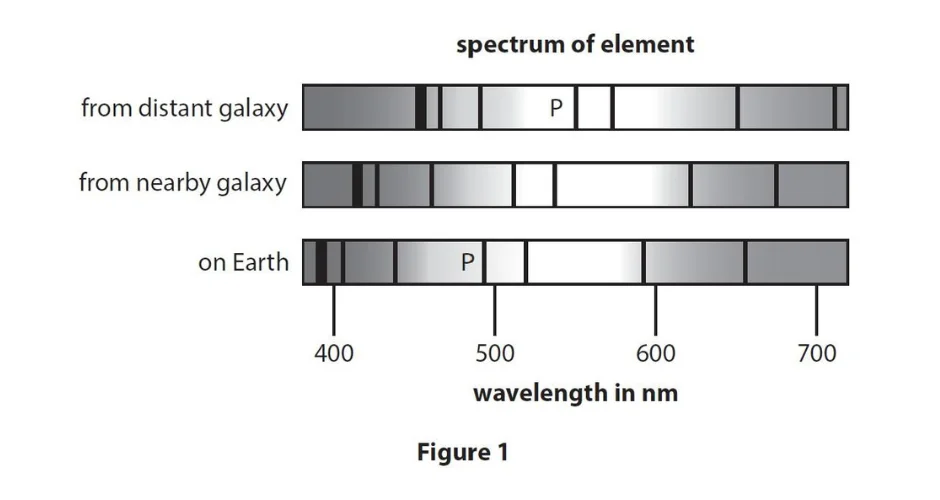
i) Estimate the difference between the wavelength of line P in the spectrum from the distant galaxy and the wavelength of line P in the spectrum on Earth.
Answer:
Difference in wavelength = 550 − 490 = 60 nm
ii) Scientists have discovered that light from almost all distant galaxies has spectral lines shifted towards the red end of the spectrum. Explain how red-shift in light received from galaxies at different distances from the Earth supports the idea that the Universe is expanding.
Model answer:
The fact that light from distant galaxies is red-shifted means that the space between the galaxies and us is expanding, causing the light waves to stretch as they travel and making the galaxies appear to move away from us. The further away a galaxy is, the larger the shift and the faster it is receding from us.
Practising questions like these under timed conditions is one of the most effective ways to prepare. For exam technique advice specific to Physics papers, see our post on the do's and don'ts of GCSE Physics papers. And for a broader revision strategy heading into exam season, how to effectively revise for your GCSEs and A-Levels is worth reading alongside this.
Conclusion
The Solar System and Universe topic is one of the most conceptually rich areas of GCSE Physics. It brings together gravity, nuclear physics, wave theory, and the nature of space and time into one coherent picture. Examiners test it through a mix of multiple choice, calculation, and extended response questions - each of which rewards a slightly different skill.
Understanding the reasoning behind the content, not just the facts, is what separates a Grade 7 answer from a Grade 9 answer. That means being able to explain why red-shift tells us the Universe is expanding, not just state that it does. It means understanding why a star becomes a red giant, not just knowing that it does.
If you want support working through this topic and others in GCSE Physics, a GCSE Physics tutor can build on each concept systematically and work through past paper questions with you until the reasoning becomes second nature.
Parents
Students
Tutors

Joseph B
Tutor
I’m a Math and Physics tutor specialising in GCSE exam preparations.



Looking for a tutor?
Sherpa has hundreds of qualified and experienced UK tutors who are ready to help you achieve your goals. Search through our tutors and arrange a free 20 minute introduction through our industry-leading online classroom.
Find a TutorSimilar Articles